Bathroom Addition
Adding a Bathroom to a Finished Basement — Complete Cost Guide 2026
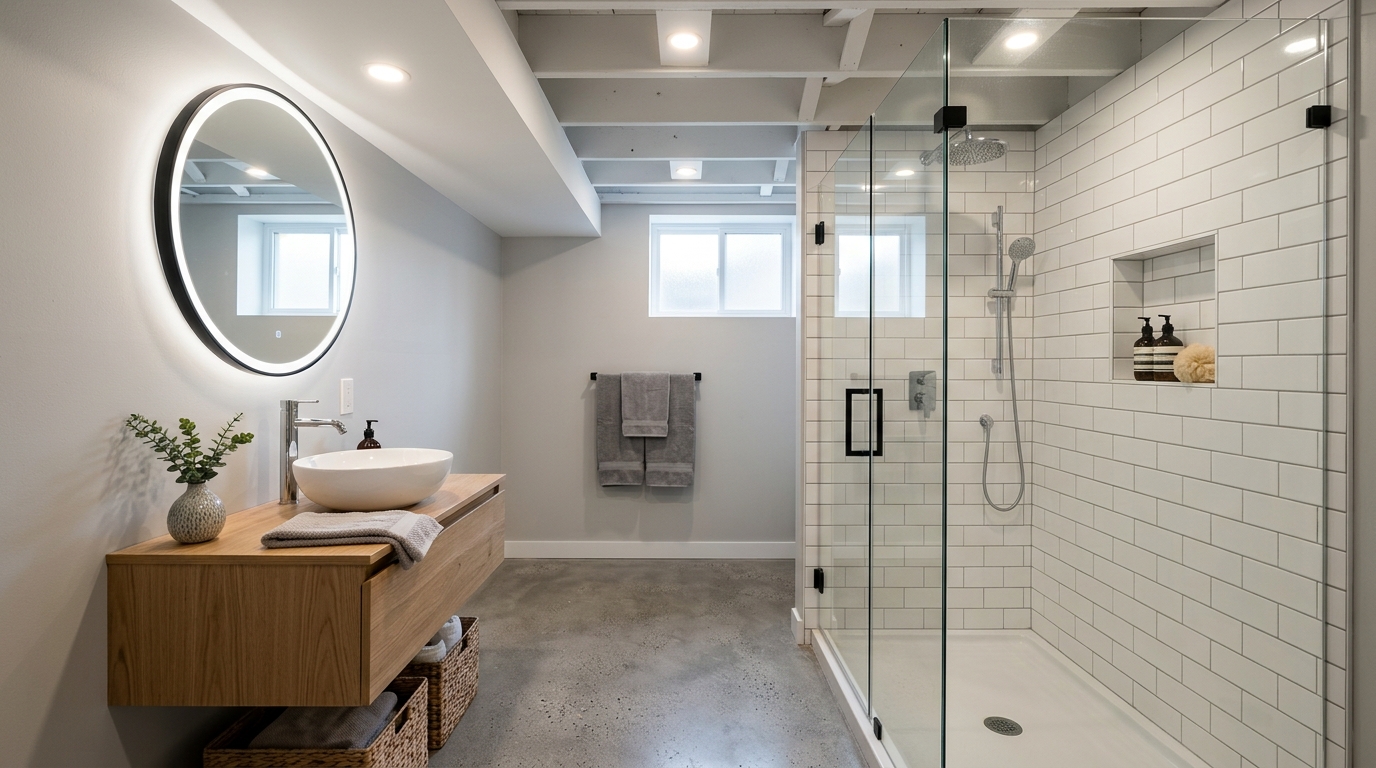
Adding a bathroom to a finished basement is one of the highest-ROI projects most homeowners can take on — it can lift home value by $10,000–$25,000 and turn a basement from "rec room" to "real living space." But the cost swing on this project is enormous. A half-bath dropped onto an existing rough-in might come in at $7,000. A full bath where you have to break concrete and add an up-flush pump can hit $35,000. Here's exactly what drives the spread, what 2026 pricing looks like by scenario, and the 5 decisions you need to lock in before you talk to a single plumber.
The 3 plumbing scenarios that determine 70% of the cost
Before anything else, walk down to your basement and look at the floor near the wall closest to the main waste line. Which of these you're working with controls the rest of the budget:
- Scenario A — You have an existing rough-in: Many homes built after ~1990 have a capped 4" PVC pipe sticking out of the slab in the basement, with a smaller water-supply stub nearby. This is the dream. Total bath-add cost: $7,000–$15,000 depending on finish tier.
- Scenario B — No rough-in, but the main line runs below the slab nearby: A plumber cuts and removes a strip of concrete (typically 3' wide × 8–15' long), installs the drain, vent, and supply, then re-pours. Total cost: $12,000–$22,000.
- Scenario C — Main waste line runs above the basement floor (or you don't want to break concrete): Install an up-flush macerator system (Saniflo or similar) that pumps waste up to the existing line. Avoids concrete work, but the pump and ongoing maintenance are real costs. Total: $9,500–$18,000.
Most homeowners assume they're Scenario A, but only about 40% of pre-2010 homes actually have a usable rough-in. Confirm by uncapping it and checking that water flows — old caps sometimes hide a crushed pipe.
2026 cost breakdown by bathroom type
Within each plumbing scenario above, the bathroom type then determines fixture, tile, and labor costs:
- Half-bath (toilet + sink, ~20 sqft): $7,000–$13,000 with existing rough-in; $11,000–$18,000 without. Simplest add; great for guest convenience.
- Three-quarter bath (toilet + sink + shower, ~35 sqft): $11,000–$19,000 with existing rough-in; $16,000–$26,000 without. The most common basement bathroom and best resale ROI.
- Full bath (toilet + sink + tub/shower, ~45 sqft): $14,000–$24,000 with existing rough-in; $20,000–$35,000 without. Worth the upgrade if you have rental potential or in-laws/teens.
- Luxury / spa basement bath (heated floors, walk-in shower, separate soaking tub):$32,000–$60,000+. Usually only makes ROI sense in homes already valued at $700K+.
Cost data sourced from 2026 contractor surveys across 12 major U.S. metros, NKBA cost benchmarks, and Bureau of Labor Statistics regional labor rates.
Where the budget actually goes (3/4 bath, $18,000 example)
- Plumbing rough-in (cut slab, drain, vent, supply): $4,000–$6,500
- Electrical (GFCI circuits, lighting, fan): $1,200–$1,800
- HVAC (heat/cooling tie-in or supplemental): $400–$1,200
- Framing + insulation + drywall + paint: $1,800–$3,200
- Fixtures (toilet, sink, shower base, faucets): $1,500–$3,500
- Tile + flooring (waterproofed): $1,400–$2,800
- Vanity, mirror, hardware, accessories: $700–$1,800
- Permits + inspections: $250–$1,200 depending on jurisdiction
- Contractor overhead + profit (15–25%): $2,400–$3,800
The 5 decisions to lock in before you bid the project
- Half, three-quarter, or full? Walk the basement and decide based on use case. A finished basement with a guest bedroom needs three-quarter minimum; a media/playroom basement can live with a half-bath.
- Plumbing path? Get a plumber in for a $150–$300 inspection BEFORE you bid the project. Confirm rough-in status + viable drain path. This single visit prevents the most expensive surprise on the entire project.
- Location? Closer to existing waste line = cheaper. Every additional 10' of concrete you have to cut adds $1,500–$2,500 (and noise/dust). Aim for a wall that backs onto the main waste stack or adjacent to a basement utility room.
- Ventilation strategy? Basement bathrooms require mechanical ventilation (no window). Specify a quality humidity-sensing fan ($150–$300 installed) — undersized fans are the #1 cause of basement-bath mold complaints.
- Permit-or-not? Always permit. An unpermitted basement bathroom can sink your sale (buyers' inspectors flag it, mortgage underwriters reject it, and many cities require remediation before close). Permit cost is typically less than 3% of project budget.
Up-flush systems: when they make sense (and when they don't)
An up-flush macerator (Saniflo, Sanibest, Liberty) is a pump system that grinds and pumps waste up to your existing main line, avoiding all concrete-cutting. Most homeowners hear about these and think they sound magical. The reality:
- Pros: No concrete work (saves $3,000–$6,000), faster install (3–5 days vs. 7–10), lower disruption (no jackhammer noise/dust).
- Cons: The pump unit itself is $700–$1,800; it can fail (typical lifespan 10–15 years and replacement costs ~$1,500 installed); it's audible during use (a quiet but noticeable hum); it limits which fixtures you can use (low-flow toilets often required); and some buyers see them as a maintenance liability that drags on resale value.
- When they make sense: Slab is too thin to cut safely (older homes), main line is above floor level (very common in older homes with cast-iron systems), or you're renovating to live-in (not resell). Otherwise, breaking concrete is usually the better long-term play.
ROI: what does a basement bathroom add to home value?
Per the 2026 Cost vs. Value Report, basement bathroom additions return roughly 62-78% of cost on resale in mid-range markets — slightly below the 70-85% return on whole-bath additions on the main floor, but importantly: a basement bath unlocks the "real bedroom" status of any adjacent basement room (a basement room without a nearby bathroom typically doesn't count toward bedroom count for appraisal/listing purposes). That bedroom-count bump can add $15,000–$40,000 to appraised value in many markets, dwarfing the direct ROI.
For specific state ROI numbers (CA, NY, TX, FL run highest because property values are higher), run our bathroom remodel cost calculator with your state selected. For basement scope and timeline, also see our basement finishing cost calculator.
Common gotchas (and how to avoid them)
- Ceiling height under 7'0": Many older basements have 6'6"–6'10" ceilings. Building codes require minimum 6'8" in bathrooms in most jurisdictions; some require 7'0". Confirm before you frame anything.
- Egress requirements: If this bathroom serves a basement bedroom, that bedroom probably also needs an egress window — that's a separate $3,500–$7,500 project most homeowners forget until the inspector flags it.
- Waterproofing the floor: Basement floors are vapor-prone. Use a proper waterproof membrane (Schluter Kerdi, Wedi, or similar) under tile. Skipping this saves $400 and costs $4,000 in mold remediation 5 years later.
- Hot water reach: If your water heater is far from the new bathroom, you may need a recirculation pump ($350–$700) or a point-of-use tankless ($600–$1,400) to avoid 2-minute "wait for hot water" delays.
Bottom line
Adding a bathroom to a finished basement is one of the most impactful renovations available to homeowners — but the cost swing is so wide that the project lives or dies on three things: existing plumbing rough-in status, distance from the main waste line, and bathroom scope. Lock those three in first; everything else (tile, vanity, fixtures) is fine-tuning around a known number. Get a plumber out for a $200 site visit before you bid the project, and you'll know your real budget within $2,000 before anyone signs anything.