Cost Guide
Average Cost to Finish a Basement by Size (2026)
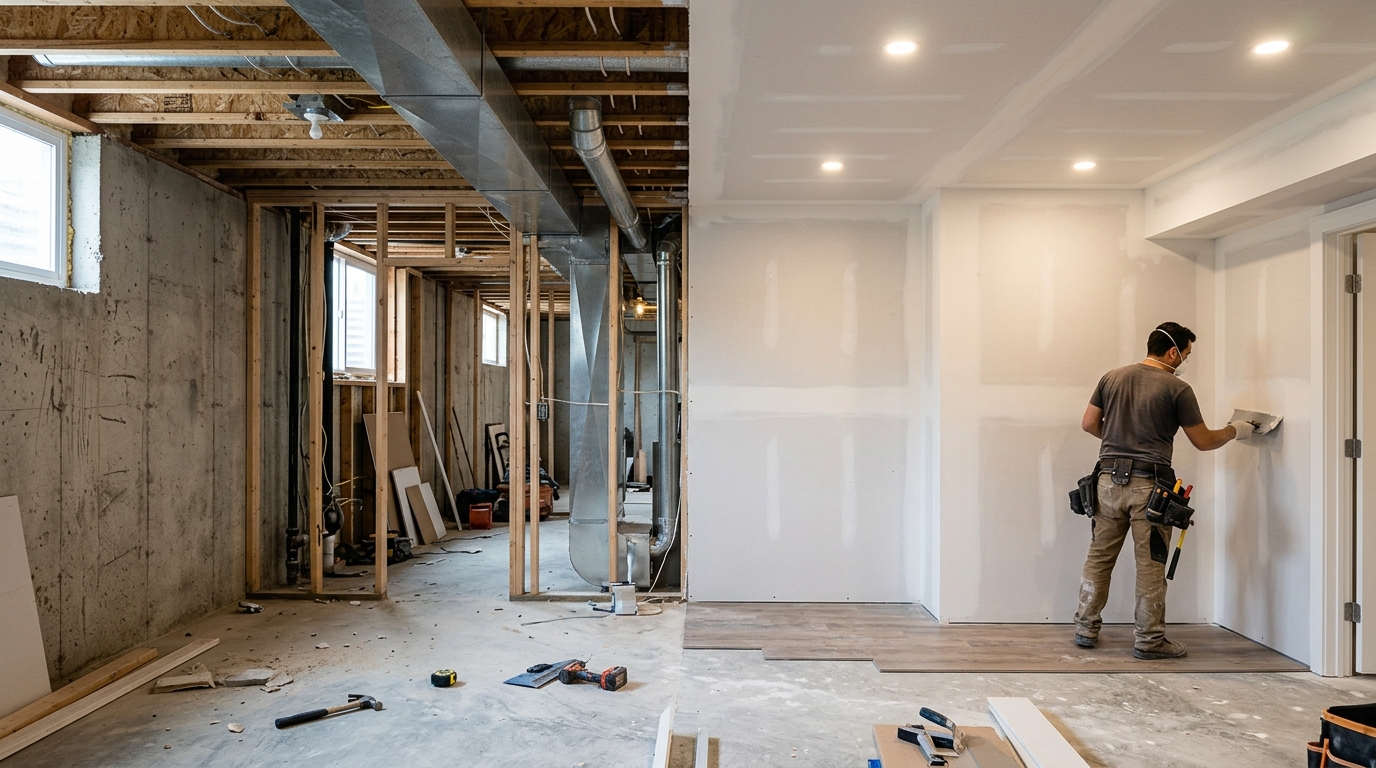
Finishing a basement in 2026 typically costs $30–$75 per square foot at mid-range quality, though the realistic range is much wider than that average suggests. A 400 sq ft basic finish can run as little as $11,000. A 2,000 sq ft full-suite buildout with bathroom, kitchenette, and bedroom can push past $150,000. Per-square-foot is the most-cited metric — but it's also the most misleading, because the biggest cost variables (egress windows, bathroom additions, ceiling height fixes) don't scale with floor area.
The 2026 size-based benchmark numbers
Below are typical total project ranges (labor + materials + permits + 10% contingency) at mid-range quality for a "basic finish" scope — framing, drywall, flooring, electrical, paint. Bathroom additions add $8,000–$22,000.
- Small basement (400–600 sq ft): $11,000–$26,000 ($28–$45/sq ft)
- Medium basement (600–1,000 sq ft): $18,000–$45,000 ($30–$50/sq ft)
- Large basement (1,000–1,500 sq ft): $28,000–$70,000 ($28–$48/sq ft)
- Extra-large basement (1,500–2,000 sq ft): $40,000–$95,000 ($27–$47/sq ft)
- Whole-basement / walkout (2,000+ sq ft): $55,000–$140,000 ($25–$45/sq ft)
Two patterns to notice: per-square-foot cost is highest for small basements (fixed costs like permits and minimum trade-show-up fees don't scale), and the high-end of each range is much higher than the low end — driven mostly by whether the project includes a full bath, a kitchenette, or a bedroom (with egress).
Cost ranges sourced from contractor pricing data, Bureau of Labor Statistics regional labor rates, and the 2026 Remodeling Magazine Cost vs Value Report. Ranges reflect a "basic finish" scope; bathroom and kitchenette additions priced separately below.
A typical 800–1,000 sq ft basic basement finish — framed, drywalled, LVP flooring, recessed lighting, single open floor plan. Realistic 2026 budget: $26,000–$42,000 at mid-range quality.
What "basic finish" actually includes
The per-square-foot numbers above all assume a "basic finish" scope. That means:
- Framing 2×4 stud walls along the perimeter and any room partitions
- Insulation in exterior walls (typically R-13 to R-19 depending on climate zone)
- Drywall with taping, mudding, and texture (Level 4 finish standard)
- Electrical — outlets every 8–12 ft, switched lighting, GFCI where required, panel upgrade if needed
- Lighting — typically recessed cans (6–12 depending on size) and 1–2 ceiling fixtures
- Flooring — LVP, engineered wood, or carpet over a moisture barrier
- Paint — primer + 2 coats, semi-gloss trim, eggshell walls
- Doors and trim — interior doors, baseboard, casing
- Permits and inspections
What it does not include: bathrooms, kitchenettes, bedrooms requiring egress, HVAC zone additions, structural waterproofing, or significant ceiling height changes. Each of those is a separate line item — and that's where size-based budgets break down.
The add-ons that blow up size-based budgets
- Full bathroom addition: $12,000–$22,000 — varies hugely depending on whether plumbing rough-in already exists in the slab. If yes, you're at the low end. If no, plan for $5,000–$10,000 just for trenching, vent, and drain work before any finishing happens.
- Half-bath addition: $7,500–$13,000 — same plumbing rough-in dynamic, but no shower means no waterproofing scope.
- Kitchenette / wet bar: $5,500–$18,000 depending on whether you're adding cabinets, a sink, a small fridge, and a microwave vs a full second kitchen. Plumbing rough-in is again the swing factor.
- Egress window for a legal bedroom: $3,500–$7,500 — requires cutting through the foundation, installing a window well, and adding proper drainage. Building code requires this for any below-grade room to legally be called a bedroom.
- Sump pump / waterproofing: $1,500–$8,000 — only needed if you have active moisture. Skip this and you'll regret it within 3 years.
- HVAC zone or new mini-split: $2,500–$7,000 — most basements need supplemental heating/cooling to be comfortable year-round. Adding to existing forced-air is cheaper; mini-split is faster.
- Raising the ceiling height (underpinning or bench-footing): $30,000–$100,000+ — a real structural project. Only justifiable in homes where the existing height is below 7' and the basement buildout is critical to home value.
Where regional cost differences hit hardest
Basement finishing is more state-sensitive than most renovations because:
- Cold-climate code adds insulation and HVAC scope (MN, WI, ND, ME, VT) — typical premium of $2,000–$5,000 for higher R-value insulation and certified envelope air-sealing.
- Coastal/hurricane states add waterproofing requirements (FL, LA, SC coastal) — adds $1,500–$4,000.
- Older housing stock (Northeast, Midwest pre-1970) often forces foundation waterproofing or remediation work before finishing can start. Budget a 15–20% contingency for these homes.
For a state-adjusted basement finish range that includes your specific scope (basic, with bath, full suite, premium), run our basement finishing cost calculator.
How to use these numbers
Per-square-foot benchmarks are useful for sanity-checking a contractor bid after you've defined scope — not for setting a budget before you know what you want. The right sequence:
- Decide your scope: basic finish, finish + bath, or full suite (bath + bedroom + kitchenette).
- Measure your basement area — exclude utility/storage rooms you'll leave unfinished.
- Multiply by the per-square-foot range above for your scope tier.
- Add the relevant add-ons (egress, sump pump, HVAC, kitchenette).
- Add 10–15% contingency for moisture surprises, ceiling height work, or material upgrades.
For a project that recoups 70–86% of its cost at resale (per Remodeling Magazine's 2026 Cost vs Value Report), a finished basement is among the highest-ROI renovations a homeowner can do — provided the moisture situation is handled and the scope matches the surrounding home's quality tier.
Related: read our basement finishing cost breakdown for the line-by-line allocation (framing, drywall, flooring, electrical, etc.), or our Texas-specific basement finishing guide for state-adjusted ranges in the largest basement-finishing market.
Sources: 2026 Remodeling Magazine Cost vs Value Report, U.S. Bureau of Labor Statistics regional labor data, and aggregated contractor pricing data from a 2025–26 national sample. Ranges assume permitted work to current IRC code; non-permitted basements typically appraise 25–40% lower than permitted equivalents.