Cost Guide
How Much Does a Deck Addition Cost? Complete 2026 Guide
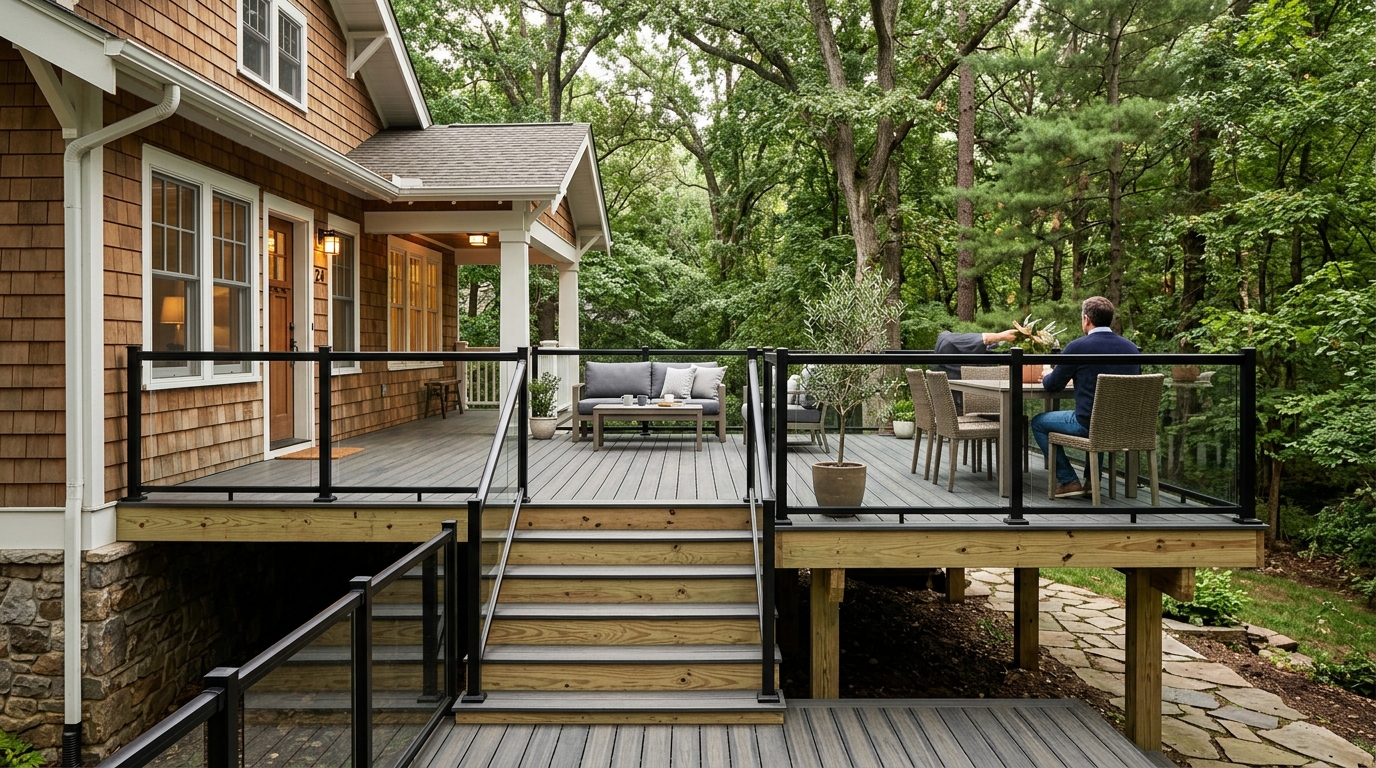
A deck addition is one of the most commonly underestimated home improvement projects in 2026. Homeowners walk in thinking "lumber and a weekend crew" and walk out staring at a $24,000 invoice — or, in California, $38,000. The price difference between two functionally identical 350 sq ft decks can be more than $25,000 depending on four decisions you'll make in the first 30 minutes of your contractor conversation. Here's everything that actually drives the number, broken down by what each choice costs, how each pays back at resale, and where the predictable overruns hide.
The 2026 national pricing benchmark
Across the U.S. in 2026, a typical deck addition costs the following ranges (mid-range quality, including labor, materials, permits, and a 10% contingency):
- Small deck (under 200 sq ft): $4,800–$10,000 (pressure-treated) · $8,500–$17,500 (composite)
- Medium deck (200–400 sq ft): $8,000–$16,500 (PT) · $14,500–$30,000 (composite)
- Large deck (over 400 sq ft): $14,500–$28,000 (PT) · $24,500–$48,000 (composite)
Premium materials (ipe, cumaru, custom railings, full-stainless cable systems) push 40–80% above these ranges. Multi-level or wraparound decks add 20–35%. Run our deck cost calculator for an instant state-adjusted, material-specific estimate.
The 4 decisions that drive 80% of your total cost
Decision 1 — Material
This is the single biggest cost lever. Here's the 2026 installed-cost-per-square-foot breakdown:
| Material | Installed $/sq ft (mid-range) | Lifespan | Maintenance |
|---|---|---|---|
| Pressure-treated lumber | $8–$14 | 15–20 yrs | Stain every 2–3 yrs |
| Cedar / Redwood | $14–$22 | 15–25 yrs | Seal every 3–4 yrs |
| Composite (Trex, TimberTech) | $22–$35 | 25–30 yrs | None (wash only) |
| PVC / capped composite (Azek) | $28–$42 | 30+ yrs | None |
| Tropical hardwood (ipe, cumaru) | $28–$45 | 40+ yrs | Oil annually |
| Aluminum decking | $32–$50 | 50+ yrs | None |
The total-cost-of-ownership reality: over 15 years, composite costs roughly the same as pressure-treated when you factor in restaining cycles. PT wins on shorter time horizons (under 7 years, e.g., rental properties or houses you'll sell soon). Composite wins for long holds.
Decision 2 — Size and shape
Cost per square foot drops as deck size grows — but most homeowners overbuild. A 300 sq ft deck holds 8 people comfortably; you don't need 500 sq ft unless you regularly entertain crowds. Going from 300 to 500 sq ft typically adds $6,000–$15,000 with marginal lifestyle gain.
- Rectangular deck: baseline cost
- L-shape deck: +8–15% (extra corner cuts, more framing complexity)
- Wraparound deck: +25–40%
- Multi-level deck: +30–50% (extra footings, stair runs, railing linear feet)
- Curved or octagonal sections: +20–35% (labor-intensive cuts and rim joists)
Decision 3 — Elevation and substructure
How high your deck sits off the ground drives a surprising amount of cost. A "ground-level" deck (under 30") needs no railing, no stair runs, and minimal footing depth. A second-story deck (8'+) requires engineered ledger attachment, lateral load connectors, full-height railings, possibly a structural engineer's stamp, and a stair run that can hit $3,000–$6,000 by itself.
- Ground-level (under 30"): baseline cost; usually no railing required
- Standard (30"–60"): +12–20% (railing + 4-step stair run)
- Elevated (60"–96"): +25–40% (taller posts, longer stairs, code-required guards)
- Second-story (8'+): +40–70% (engineered ledger, lateral connectors, full stair flight, sometimes structural engineer required)
Decision 4 — State and labor market
The same 350 sq ft composite deck swings from $19,500 in Mississippi or West Texas to $38,500 in coastal California or the New York metro. Approximate 2026 state multipliers vs. the U.S. national average:
- High-cost (CA, NY, MA, CT, NJ, HI): 1.4× national average
- Mid-high (WA, CO, OR, IL Chicago, MD, VA): 1.15× national average
- Baseline (TX, FL, AZ, NC, GA, OH): 1.0×
- Mid-low (PA non-metro, TN, IN, KY, MO, WI): 0.92×
- Low (MS, AR, OK, KS, NE, IA, ND, SD, AL, WV): 0.82–0.88×
For state-specific deep dives, see our California deck cost guide or the auto-generated deck calculator state pages.
Full cost breakdown — typical medium composite deck (national average)
For a 350 sq ft composite deck at mid-range quality, U.S. national average, total $24,000:
- Labor (50%): $12,000 — framing (3–5 days), composite install (3–4 days), railing & finishing (1–2 days)
- Materials (35%): $8,400 — composite decking $3,800, framing lumber + hardware $2,400, railing $1,300, fasteners + footings $900
- Permits & fees (5%): $1,200 — building permit, plan check, 2–3 inspections
- Contingency (10%): $2,400 — soil/excavation surprises, hardware upgrades, weather delays
What contractors don't itemize (and where the overruns hide)
- Footings & site prep. Concrete pier footings sound trivial — they're not. A medium deck needs 6–10 footings, each requiring 1 cubic foot of concrete and 24–48" of excavation. Rocky soil, tree roots, or buried utilities can double the labor on this phase alone. $400–$1,500 of variance is typical.
- Ledger flashing. The metal flashing that protects where the deck attaches to the house is the #1 source of long-term moisture damage. Cheap contractors skip the proper Z-flashing detail. Pay the extra $200–$400 to do it right.
- Lateral load connectors. Required by IRC R507.9 anywhere the deck is more than 30" off grade. Hardware cost is only $150–$300, but if it gets missed in the original bid and the inspector requires it, it's a frustrating change order.
- Stair lighting and railing lighting. Often added late in the project. Budget $300–$1,200 for low-voltage stair-step lights and post-cap lights if you want them.
- Permit re-submissions. If your local building department rejects the plans on first submission (very common in CA, NY, FL), the second submission usually adds $200–$500 in fees and 1–3 weeks of delay.
ROI: how much value does a deck addition return at resale?
The 2026 Remodeling Cost vs Value Report shows wood deck additions recoup roughly 83–87% of cost at resale — one of the highest returns of any renovation category. Composite decks return slightly less (67–73%) because of the higher upfront cost, but make up the difference in lifestyle value (no restaining, less maintenance).
The decks that consistently overperform the ROI average share three traits: (1) they're sized proportionally to the house (not oversized), (2) they connect smoothly to interior living spaces via existing slider/French doors, and (3) they use materials consistent with the home's overall finish level (don't put a $40k composite deck on a $200k house).
Permits, code, and the inspections you can't skip
Almost every U.S. municipality requires a permit for new deck construction. The trigger thresholds vary slightly, but the universal rule is: any deck attached to the house, more than 30 inches above grade, or larger than 200 sq ft requires a permit. Almost every deck homeowners actually want crosses at least one of those lines.
Typical 2026 permit costs:
- Low-cost states (TX, FL, OH, GA, AZ): $150–$400
- Mid-cost states (CO, WA, IL, MD): $300–$700
- High-cost states (CA, NY, NJ, MA): $400–$1,200
Don't skip the permit. Skipping is the #1 reason deck work fails at resale — the buyer's inspector finds the unpermitted addition and either kills the deal or forces retroactive permitting (2–4× original permit cost).
Timing your build for the lowest cost
Deck pricing is highly seasonal. Most regions hit peak demand between April and August. The cheapest booking windows in 2026:
- November–February: 10–15% lower bids in most U.S. regions; longer lead times to start but a real discount available. Best in Sun Belt states where winter weather doesn't delay framing.
- September–October: The "post-peak shoulder" — crews are looking to fill October calendar and will often discount 5–10%.
- Worst time to book: March–May. Demand peaks, lead times stretch, bids run 8–12% over off-season pricing.
5 questions to ask any deck contractor before signing
- Are you including proper Z-flashing at the ledger, and can you point that out on the plan?
- Are lateral load connectors (Simpson DTT2Z or equivalent) included if my deck is over 30" off grade?
- What's your footing depth — and how does it adjust if you hit rock or tree roots during excavation?
- Who pulls the permit — you or me? And what's included if the plans get rejected on first submission?
- What's the spec for the railing fasteners — stainless or galvanized — and will that match the area's salt-air exposure if applicable?
FAQ
How much does it cost to build a 300 sq ft deck in 2026?
A typical 300 sq ft mid-range deck costs $7,500–$13,500 in pressure-treated lumber and $13,500–$23,500 in composite at the U.S. national average. California and New York metro pricing runs 30–40% higher.
Is a composite deck worth the extra cost over pressure-treated?
For long holds (7+ years), yes — composite eliminates the recurring $1,000–$2,500 restaining cost every 2–3 years and lasts 25+ years with no degradation. For shorter holds or rental properties, pressure-treated is the better economic call.
Do I need a permit for a deck?
Yes, in almost every U.S. municipality if your deck is attached to the house, more than 30 inches above grade, or larger than 200 sq ft. Skipping the permit creates real liability at resale.
Run a personalized estimate
Get a state-adjusted, material-specific deck cost estimate in under 60 seconds: deck cost calculator. Want a state-specific breakdown? Try the California deck guide or the auto-generated state pages from the calculator.