Hiring & Bids
How to Read a Contractor's Estimate — The 2026 Line-Item Decoder
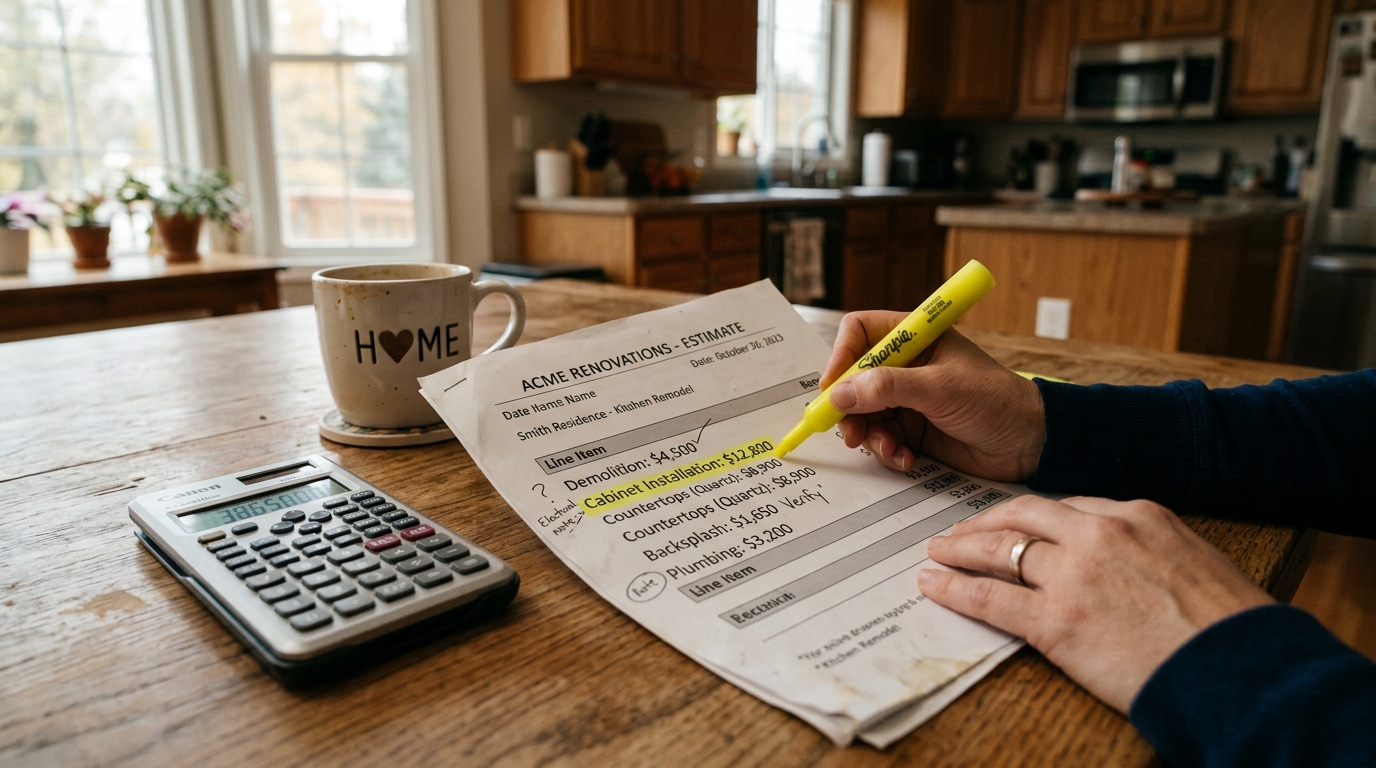
A contractor's estimate is the single most important document in any renovation. It's also the document most homeowners glance at, see a total, and sign — which is how every "but I didn't know that wasn't included" surprise starts. In 2026, with material prices still volatile and labor up 6–9% in most states, the cost of misreading an estimate is bigger than ever. Here's how to actually read one.
The 12 line items every honest written estimate should include
If your contractor's quote is missing any of these, ask for them in writing before you sign anything:
- Project scope summary. One paragraph describing exactly what will be built, demolished, or finished. Vague scope = vague price.
- Labor cost (separated). Total labor hours and rate, ideally broken out by trade (carpentry, electrical, plumbing, tile).
- Materials list with allowances. Every major material itemized with quantity and unit cost. "Allowances" (placeholder $ amounts for tile, fixtures, etc.) clearly flagged as such.
- Demo and disposal. Tear-out labor + dumpster rental + dump fees. Routinely costs $500–$2,500 and routinely left out.
- Permits and inspections. Which permits will be pulled, by whom, and the fee. Most projects need 1–3 permits at $150–$1,200 each.
- Subcontractor breakouts. Plumbing, electrical, HVAC subs named (or marked "TBD") with their portion of the bid. Important for accountability.
- Equipment and rentals. Scaffolding, lifts, specialty saws. Usually 1–3% of project cost; should be visible, not buried.
- Contractor overhead and profit. Typically 15–25% combined. If your GC won't tell you their O&P percentage, you have the wrong contractor.
- Contingency. 10–15% line item for unknowns. If it's missing, the contractor is either inexperienced or planning to hit you with change orders later.
- Timeline. Start date, expected completion date, and the milestone schedule. Should be in writing, not "we'll start in a few weeks."
- Payment schedule. Deposit, progress payments tied to milestones, final payment after inspection. Never pay more than 30% upfront.
- Warranty and lien-waiver terms. What the contractor warranties, for how long, and confirmation they'll provide lien waivers from subs at each payment.
The 6 red flags that mean walk away
- "It'll be around $30,000." Verbal estimates aren't bids. Anyone who won't put it in writing is shopping themselves to multiple homeowners and will price-discriminate after the fact.
- Lump-sum total with no breakdown. "$48,500 — total" with no line items means you can't compare bids and you can't dispute charges. Always demand itemization.
- Massive deposit (40%+ upfront). Industry standard is 10–20% on signing, 25–30% absolute max. Bigger deposits indicate cash-flow problems on the contractor's end.
- No mention of permits. Either they're skipping permits (illegal, kills resale) or they expect you to pull them (which transfers all liability to you).
- Pricing 30%+ below other bids. Either they missed scope or they plan to load you up with change orders. The lowest bid is almost never the cheapest job.
- No proof of license, bond, or insurance. Ask for certificates. Verify the license number on your state's contractor board website. Uninsured = your homeowner's policy pays if something goes wrong.
What "allowances" really mean (and how they bite you)
Allowances are placeholder dollar amounts the contractor inserts for items you haven't picked yet — usually tile, plumbing fixtures, lighting, cabinet hardware, and countertops. Example: "Tile allowance: $8 per square foot, supply only." If you fall in love with $14/sqft tile during selection, the difference is on you. Allowances are normal and necessary, but here's how to avoid the surprise:
- Ask what the allowance buys at that price. "$8/sqft tile" — show me three options that meet this number. Most homeowners discover the allowance covers builder-grade material only.
- Tour a showroom BEFORE signing. If the allowance is $400/sqft for countertops and you want quartz, find out today what $400 actually gets you. Adjust the allowance up if it's unrealistic.
- Get every allowance overage in writing. If you upgrade tile from $8 to $11/sqft, get the new total ($3 × sqft × tax) confirmed in a change order, not a verbal "I'll work it out."
How to spot scope creep before you sign
Scope creep starts in the estimate, not during the job. Look for these vague phrases — each one should be replaced with a specific number or item before signing:
- "Touch up paint as needed" → How many rooms? Which walls? Which color?
- "Standard fixtures" → Specify make, model, and finish.
- "Repair as required" → Cap at a dollar amount. After that, change order.
- "To match existing" → Include a sample photo or product number; "matching" is subjective.
- "Subject to site conditions" → What conditions? What's the cap on additional charges?
The change-order clause — most important paragraph in the contract
Every renovation has changes. The change-order clause defines how those changes are priced, approved, and documented. A good clause has 4 elements:
- Written approval required. No work begins without your signature on the change order.
- Written quote within 48 hours. Contractor gives you the cost and timeline delta in writing, not "I'll figure it out at the end."
- Markup cap. Typically labor + materials + 15–20% overhead/profit. No surprise 50% markups on change-order items.
- Schedule impact disclosed. Each change order states how many days it adds to the project. Otherwise "minor changes" silently turn a 6-week job into 12.
Comparing 3 bids side-by-side
The honest way to compare bids isn't bottom-line price — it's scope-normalized. Build a simple spreadsheet:
- One row per line item from the most detailed bid.
- One column per contractor.
- Fill in each contractor's number for each line. Blanks = "not included."
You'll usually find: Bid A is cheapest because it's missing demo + permits ($2,800 not in scope), Bid B is most expensive because it includes a higher tile allowance and longer warranty, Bid C is in the middle and has the most complete scope. The middle bid is right ~70% of the time.
Estimate vs. quote vs. proposal vs. bid — what's the difference?
- Estimate: Rough cost projection, non-binding. Often verbal or napkin-level. Don't sign anything.
- Quote: Specific price for specific scope, usually binding. Should include all 12 line items above.
- Proposal: Quote + project narrative + timeline + payment schedule. Most professional GCs deliver these.
- Bid: Formal quote submitted in response to a defined scope (often used in competitive bidding scenarios). Always binding once accepted.
Always ask: "Is this a binding quote or a rough estimate?" The answer determines your protection.
The honest pricing checklist before you sign
- ✓ All 12 line items above present and itemized
- ✓ 3 written bids compared scope-by-scope (not just totals)
- ✓ License, bond, insurance certificates verified
- ✓ References called (at least 2 from the last 12 months)
- ✓ Allowances clarified in person at a showroom
- ✓ Change-order clause has all 4 elements
- ✓ Payment schedule front-loaded ≤30%, tied to milestones
- ✓ Timeline includes start, finish, and 4–8 week buffer
Once your estimate passes this audit, you're ready to sign — and you'll spot the change orders coming a month before they hit. Want a state-adjusted baseline number to compare against your bids?
- Bathroom remodel cost
- Kitchen remodel cost
- Roof replacement cost
- Basement finishing cost
- Solar panel cost
Sources: National Association of Home Builders 2026 contract guidance, Remodeling Magazine 2026 Cost vs Value Report, contractor pricing data from a 2025–26 national sample (n=140 U.S. GCs), Better Business Bureau renovation-complaint analysis 2024–25.