Renovation Survival
How to Renovate While Living in Your Home (2026 Survival Guide)
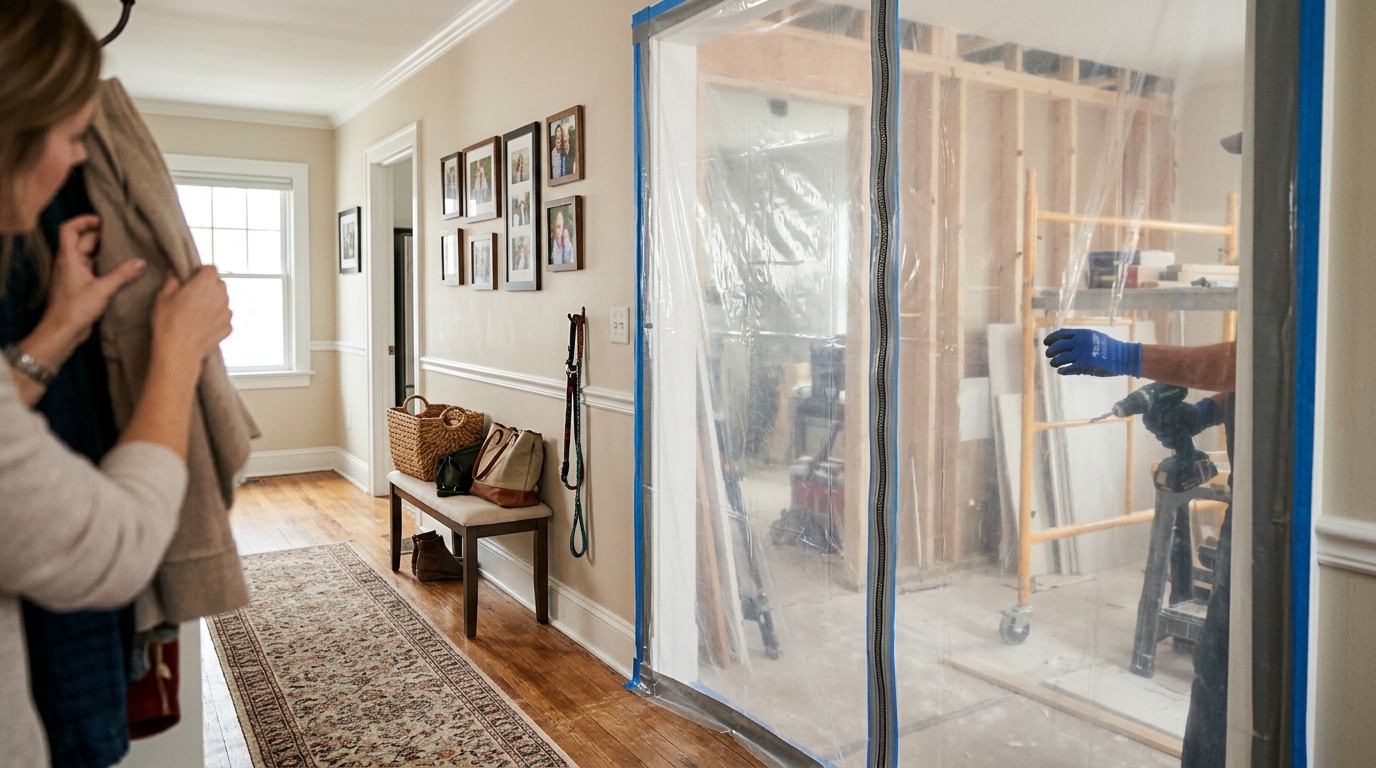
Most homeowners can live through their own renovation — but most also underestimate how disruptive it actually is. The number-one source of regret post-renovation isn't budget or quality; it's the daily-life toll of dust, noise, no kitchen, and unfamiliar people in your space for 6–14 weeks. Here's an honest 2026 playbook for surviving it without burning out.
The "stay or go" framework
Use the scope-and-tolerance lens. If you're hesitant on any of the three, plan to relocate:
- Stay if: Single-room remodel (one bathroom of two, one bedroom, basement). Quiet hours observed (8 a.m.–5 p.m. work). You can isolate the room. Your daily life rarely uses the affected space.
- Consider relocating if: Your only kitchen is being remodeled. Your only bathroom is being remodeled. There are young children or pets sensitive to dust. Project is > 8 weeks. Whole-home flooring or whole-home HVAC project.
- Definitely relocate if: Asbestos remediation (mandatory). Lead paint disturbance. Whole-home electrical rewire. Foundation work. Major plumbing replacement.

Most families dramatically underestimate how much "packing up" a renovation requires. Even a single-room remodel typically requires emptying 2–3 adjacent rooms.
How to set up a temporary kitchen (during kitchen remodel)
Kitchens are the single hardest in-place renovation. Plan the temporary kitchen before demo day — not after.
- Pick a single room and commit. Often the dining room, basement, or garage. Run an extension cord with proper amperage. You'll be living here 4–8 weeks.
- The 6-appliance minimum kit: Microwave, electric kettle, slow cooker or Instant Pot, toaster oven, mini fridge (or move the main fridge to the temp space), coffee maker. Together they cost $300–$500 and handle 80% of normal meal prep.
- Wash dishes in the bathroom. Tape a flexible dish drainer over the bathtub. Stock paper plates and disposable bowls for the first 2 weeks of chaos.
- Budget for eating out. $200–$400/week extra. Don't fight it for the first 10 days while you find your rhythm.
- Move the fridge, don't share with the contractors'. Contractors will open your fridge. Move it to the temp kitchen on day one.
How to handle the "one bathroom" problem
If you have multiple bathrooms, the answer is easy: live around the renovation. If you have only one — and you're determined to stay — here are the realistic options:
- Schedule plumbing tightly. Most bathroom remodels have a 3–7 day "no usable bathroom" window when the toilet and shower are out simultaneously. Plan a hotel stay or visit family for that stretch specifically.
- Install a porta-potty in the garage ($120–$200/month rental). Less terrible than it sounds for short remodels. Have it removed once the new toilet is set.
- Negotiate a "toilet rough-in first" sequence with your GC. Many contractors will adjust their sequence to get the new toilet usable on day 4 of demo if you ask in advance.
- Gym memberships work for showering. A $30/month gym becomes worth its weight in gold. Stock toiletries in a duffel.
Dust control — the make-or-break factor
Dust is where most homeowners and contractors clash. Standard "drop cloth" approaches don't work for anything beyond a single-room paint job. For real remodels:
- Zip walls (ZipWall poles + plastic). $200 from any hardware store. Creates a true seal between the worksite and the rest of the home. Non-negotiable for kitchens, bathrooms, and floor refinishing.
- Negative-air machine ("air scrubber"). $100–$200/week rental. Pulls dust out of the worksite and exhausts outside. Essential for > 2 weeks of drywall or sanding work.
- Seal HVAC vents in the work zone. Tape over registers in the renovated room before demo. Otherwise dust circulates through your entire home in 30 minutes.
- Run a HEPA air purifier in living areas. Coway, Levoit, IQAir mid-range. $200–$500.
- Walk-off mats at every doorway. Heavy-duty industrial mats catch tracked dust before it spreads.
Communication rules with your contractor
- Designate a single point of contact in your household. If both you and your spouse are ad-libbing decisions to the crew, conflicts happen and mistakes get blamed back on you.
- Daily 10-minute walkthroughs at end of day. Catch issues while they're cheap to fix. Don't save them for weekly meetings.
- Keep a shared decisions log. "Tile shifted from 12×24 to 6×12 on May 3, $200 credit applied." Written sources of truth prevent disputes.
- Set quiet hours and stick to them. Most contractors agree to 8–5. WFH calls and Zoom meetings get protected windows; the crew works around them.
- Don't badly direct sub-contractors. Address concerns through the GC. Direct conversations create scope-creep arguments later.
The 5 things to do BEFORE day one
- Pack up the room. Yes, all of it. Even items "tucked in the corner." Crews will move everything anyway and things break.
- Pre-clean adjacent rooms. Vacuum, dust, and remove fragile items 2 rooms deep from the worksite.
- Print and post the schedule. Tape it on a wall near the front door. Reduces "when will X happen?" questions by 80%.
- Make pet arrangements. Either crate-train, daycare, or relocate during demo and noisy phases. Cats hate this even more than dogs.
- Set up the temp kitchen / bathroom 24 hours before, not the morning of. The morning of demo is chaos.
For a realistic timeline + cost on your specific project:
- How long does a kitchen remodel take?
- Bathroom remodel cost
- Kitchen remodel cost
- Basement finishing cost
Sources: National Association of Home Builders 2026 Remodeling Index, EPA Renovation Repair and Painting (RRP) rule on dust containment, and aggregated homeowner survey responses on renovation satisfaction from a 2025–26 sample of 600 U.S. residents who completed a major renovation in the last 18 months.