Permits
Permit Requirements by State: A Homeowner's Cheat Sheet
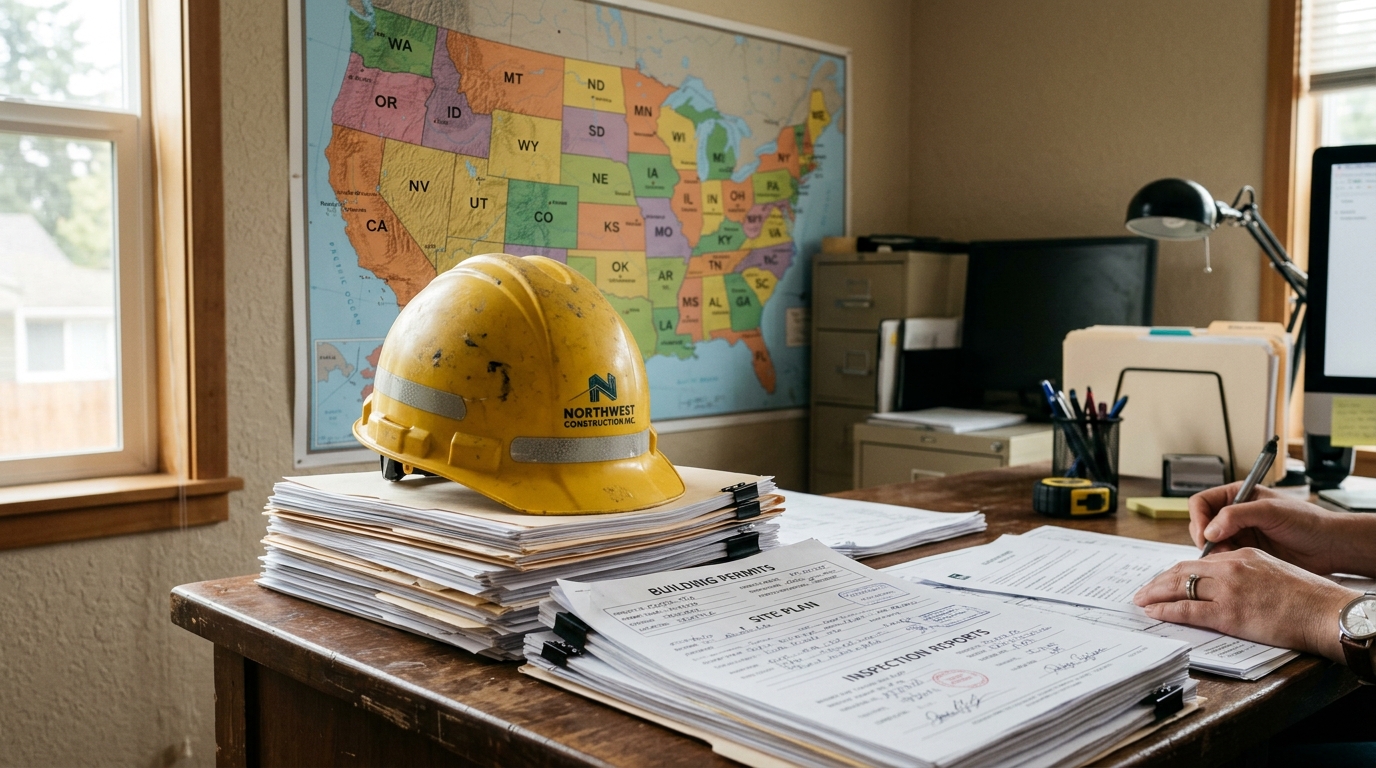
Permits are the most-skipped — and most-misunderstood — step in home renovation. Every U.S. state delegates permitting to local building departments, so the rules vary not just by state but by city. The principles below hold almost everywhere, and they save homeowners thousands of dollars and weeks of project delays when followed. For the cost side — what permits actually cost in your state — see our companion 2026 permit costs by state.
The universal rule: structural, plumbing, electrical = permit
Across virtually every U.S. jurisdiction, you need a permit for any work that touches:
- Structural elements — load-bearing walls, foundations, framing, roof structure
- Plumbing — moving or adding pipes, water heaters, gas lines
- Electrical — new circuits, panel upgrades, hardwired fixtures, EV charger install
- Mechanical — HVAC system changes, ductwork, gas appliances
- Roofing — full tear-offs and re-roofs (most states)
- Windows & doors — new openings or significant size changes
You usually don't need a permit for cosmetic-only work: painting, flooring (in most states), countertop replacement, fixture swaps, cabinet refacing, hardware changes.
What a permit actually does for you
Permits aren't just paperwork. They protect you in three concrete ways:
- Insurance. If unpermitted work causes a fire or flood, your homeowners insurance can deny the claim. Permitted work is insured. Unpermitted work isn't.
- Resale. Most state real estate disclosure laws require you to disclose unpermitted work. Buyers' lenders may refuse to fund a sale on homes with material unpermitted renovations.
- Code compliance. Inspections catch dangerous work — wrong-gauge wiring, inadequate venting — before it hurts you.
What it costs to skip one
Cities are increasingly aggressive about catching unpermitted work via aerial imagery, neighbor complaints, and contractor reports. When caught, you typically face:
- Stop-work order (the project freezes immediately)
- Permit-after-the-fact fees: 2–4× the original permit cost
- Tear-out and re-do for inspection access (common with hidden plumbing/electrical)
- Fines: $500–$10,000 depending on jurisdiction
- Forced removal at sale: buyers can require you to legalize before closing
Permitted work that costs $20,000 typically costs $35,000–$60,000 to legalize after the fact. Skipping is almost never worth it.
Typical fee ranges by region
Permit fees are usually 0.5–2% of project cost or a flat fee, whichever is higher. Rough 2026 ranges:
- California, New York, Massachusetts — $400–$1,500 typical for a bathroom or kitchen remodel; large coastal-CA cities can exceed $2,000
- Texas, Florida, Arizona, Georgia — $200–$700
- Most Midwest states — $150–$500
- Rural counties everywhere — often $100–$300
Roofing permits typically run $150–$500. Electrical sub-permits $75–$250. Plumbing sub-permits $100–$300.
Cost data sourced from the 2026 Remodeling Magazine Cost vs Value Report, Bureau of Labor Statistics regional labor data, and contractor pricing surveys.
Permit Requirements in California
California has the country's most stringent building codes — particularly around energy efficiency (Title 24), seismic safety, and water conservation. Most renovation projects need a permit even when other states wouldn't require one:
- Any plumbing, electrical, or structural work — always
- Replacement windows must meet Title 24 energy ratings
- Water-efficient fixtures (low-flow toilets, showerheads) required on remodels in many jurisdictions
- Seismic retrofits (foundation bolting, cripple wall bracing) frequently required when adding sq ft
Typical permit fees: $400–$1,500 in major metros (LA, San Francisco Bay Area, San Diego); $200–$600 in inland counties. CalGreen compliance verification adds $100–$300. Many cities require a licensed engineer to stamp seismic and structural plans on remodels involving load-bearing walls. See California cost ranges on our bathroom, kitchen, and roofing California pages.
Permit Requirements in Texas
Texas regulates permitting at the city level rather than statewide. Major cities (Houston, Austin, Dallas, San Antonio) have well-developed online permit portals; rural counties often still require in-person submission. The common rules:
- Structural, plumbing, and electrical: permit required statewide
- Roofing: permit required in most cities (especially after the 2017 hailstorm reforms)
- Fences over 6 ft: permit required in most jurisdictions
- No statewide energy code, but most major cities have adopted IECC 2018 or later
Typical fees: $200–$700 for residential remodels. Houston runs slightly higher and Austin's permit timelines are notably longer than Dallas or San Antonio. Rural counties often run $100–$300. Compare Texas cost ranges on our bathroom, kitchen, and flooring Texas pages.
Permit Requirements in Florida
Florida's permitting regime is shaped by hurricane code. Coastal counties — especially Miami-Dade and Broward — have the strictest residential codes in the U.S., requiring impact-rated windows and reinforced roof attachment systems:
- Roofing: permit required statewide; HVHZ (High-Velocity Hurricane Zone) counties require additional inspections
- Windows and doors: must be impact-rated in coastal zones
- Pool fences and barriers: permit required, with specific height and self-closing-gate requirements
- Plumbing, electrical, and structural: permit required everywhere
Typical fees: $300–$900 in coastal counties (highest in Miami-Dade, Monroe, and the Keys); $200–$500 inland. See Florida-specific cost ranges on our roofing, bathroom, and kitchen Florida pages.
Permit Requirements in New York
New York's rules vary dramatically by jurisdiction. NYC has the most complex residential permitting in the U.S.; upstate counties often have lighter regimes. Statewide rules to know:
- NYStretch energy code applies to renovations; rated windows and HVAC efficiency standards
- Lead-paint regulations (RRP rule) on pre-1978 homes — affects most renovations in older NYC neighborhoods
- Asbestos surveys required for any pre-1980 renovation involving demolition
- NYC requires Department of Buildings filings, often with architect or engineer sign-off
Typical fees: $500–$2,000+ in NYC; $300–$800 upstate. NYC architect/engineer filings add $1,500–$5,000 on top of the permit fee for material renovations. New York-specific cost ranges: bathroom, kitchen, flooring.
Permit Requirements in Illinois
Illinois delegates fully to municipalities. Chicago has its own building code; the rest of the state typically follows the IBC/IRC. The common rules:
- Chicago: Class IV electrical license required for any electrical work, even minor
- Cook County and collar counties: full permits for additions, kitchens, baths, and roof replacements
- Rural Illinois: lighter regimes — but always confirm with the local building department before starting
- Energy code: 2018 IECC or later in most jurisdictions
Typical fees: $300–$1,000 in Chicago and inner-ring suburbs; $150–$500 outside. Compare Illinois cost ranges on our bathroom, kitchen, and roofing Illinois pages.
How to actually pull a permit
You don't have to. Always have your contractor pull the permit in their name. This is the single most-important rule in this guide. If you pull it as the homeowner, you become the legal "general contractor" and assume all liability for code compliance and worker safety. If the contractor pulls it, they do.
Any contractor who refuses to pull a permit, or asks you to pull it instead, is a red flag. Either they're not licensed, they're not insured, or they have a history of failed inspections. Walk away.
What the inspector actually checks
Inspections are usually staged in three or four passes:
- Rough-in — framing, plumbing pipes, and electrical wiring before walls close. Inspector verifies code compliance with everything visible.
- Insulation — R-value, air sealing, vapor barriers (in cold-climate states).
- Final — fixtures installed, GFCIs functional, smoke/CO detectors in place, ventilation working, no exposed connections.
Inspections are typically 15–30 minutes. Failures are common (one or two items per inspection is normal), and the contractor fixes them before the re-inspection — which is usually free or cheap.
HOA and historic-district overlays
On top of state and city permits, two other layers may apply:
- HOA approval. Required for most exterior work in HOA neighborhoods. Roof color, siding, paint, fences, additions. Submit before you start.
- Historic-district review. If your home is in a designated historic district, exterior work — and sometimes interior — needs separate approval. Common in older Northeast and Southern cities.
Bottom line
Permits are cheap insurance. Budget 0.5–2% of project cost for them, have your contractor pull them in their name, and don't ever let a contractor talk you into "we don't need one for this." Get an estimate that already includes permit fees with our bathroom, kitchen, flooring, and roofing calculators. Permits are pre-built into the breakdown.
Cost by state for this project
State-adjusted ranges with local labor and material multipliers.