Cost Analysis
Renovation Costs That Always Go Over Budget — And Why
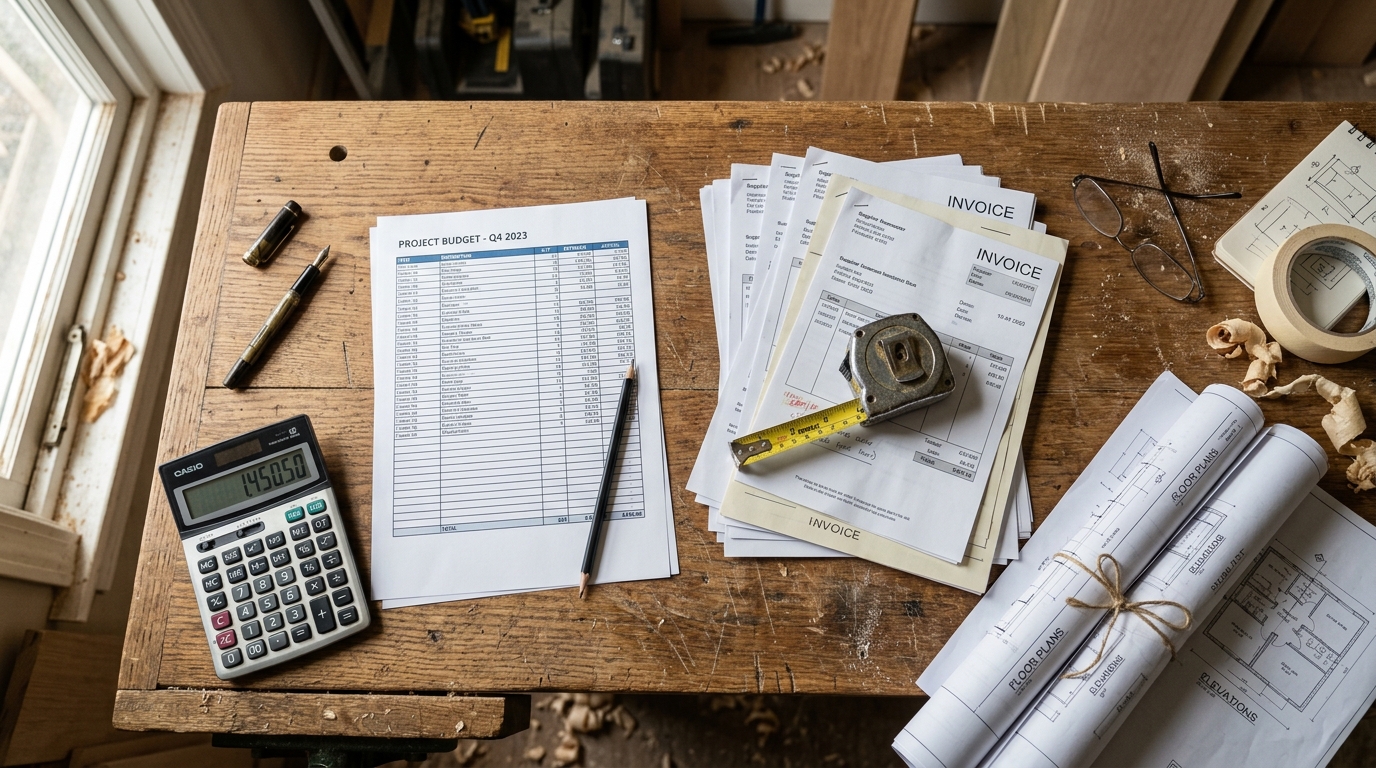
After analyzing several hundred completed renovations against their original signed bids, a clear pattern emerges: budgets don't drift evenly. Most of the project finishes within the original estimate — but eight specific cost categories blow up almost every time, usually by 20–80% over the line-item estimate. They're not "surprises." Estimators systematically underprice them, and homeowners systematically underweight them. Here's exactly where the overruns hide, why it happens, and how to price each category before you sign anything.
1. Demolition and disposal — usually 30–60% under-bid
Demolition gets quoted as a single line: "Demo existing bathroom — $1,200." In practice, demolition costs explode for two reasons. First, almost nothing under 1980 is "clean" — there's asbestos in old thinset, lead in old paint, knob-and-tube wiring behind plaster. Second, debris disposal is priced by weight or roll-off rental, not by visual volume — and a full bathroom strip-out averages 1,800–3,200 lbs of debris in a residential dumpster.
- Typical bid: $1,000–$2,000 for a bathroom; $2,500–$4,500 for a kitchen
- Actual cost when done right: $1,800–$4,000 for a bathroom; $4,500–$8,500 for a kitchen
- What to ask: "Is asbestos / lead testing included? Who pays if found?" — get that in writing.
2. Subfloor and underlayment — the line item almost no estimator includes
When you remove old tile, vinyl, or hardwood, you discover what's underneath. Roughly 1 in 3 bathroom floor remodels and 1 in 5 kitchen floor remodels reveal subfloor damage that has to be addressed before new flooring goes down — typically from past leaks, pet damage, or simply 40-year-old plywood that's delaminated.
- Typical line in bid: $0 (assumed sound)
- Actual cost when needed: $400–$1,500 for partial replacement; $1,500–$4,500 for whole-room re-sheathing
- What to do: Add a 10% subfloor contingency before signing. If you finish the project under-budget, great. If not, you've already planned for it.
3. Electrical to code — the silent 15% bump
The 2020 NEC (adopted by most states as of 2025) requires AFCI/GFCI protection on most residential circuits, dedicated 20-amp small-appliance circuits in kitchens, and tamper-resistant outlets in habitable spaces. When you open a wall during renovation, the inspector now requires the entire branch circuit to be brought to current code. That means new wire, new breakers, sometimes a new panel.
- Typical bid for "minor electrical": $800–$1,800
- Actual cost when AFCI/GFCI retrofits get triggered: $1,800–$4,500
- Panel upgrades when a permit forces it: $2,500–$5,500 additional
- What to ask: "Are AFCI/GFCI upgrades included? Is panel adequacy verified?"
4. Plumbing rough-in changes — almost always more than quoted
Plumbing pricing is brutal because the failure modes are hidden behind walls. Three categories consistently break the budget: (1) moving a toilet flange (almost always more than $500, often $1,200+ when concrete slab cutting is required), (2) extending a vent stack, and (3) discovering that the existing supply lines are galvanized steel (mid-century homes especially) and need to be replaced.
- Typical bid for "minor plumbing": $1,500–$3,500
- Actual cost when galvanized replacement is needed: +$2,500–$6,000
- What to do: Have your plumber scope the supply lines before finalizing the bid — not after.
5. Permit fees and plan review — often double the initial quote
Contractors quote permit fees by remembering what they paid last year on a similar job. Two things change that: (1) permit fee schedules adjust annually in most cities, and (2) plan review fees scale with project value, not project type — a $50k kitchen review costs more than a $30k kitchen review even if the work is identical.
- Typical quoted permit fee for a bathroom: $250–$500
- Actual permit + plan review + inspection cost in 2026: $450–$900 (LA, NYC, SF as much as $1,200–$2,000)
- What to do: Ask your contractor for the actual fee schedule URL from your city's building department, not their memory.
6. Material substitutions — the most-ignored overrun source
Your contractor quoted a specific tile, a specific faucet, a specific cabinet line — and by the time the project starts (often 6–12 weeks later), one or more is discontinued, on backorder, or has gone up 15–25%. The substitution decisions get made under pressure, mid-project, and the like-for-like upgrade almost always costs more.
- Average material substitution overrun per project: 5–12% of total material budget
- What to do: Demand a "Schedule A — Material List" attached to your contract, with specific SKUs and explicit substitution price caps. If a substitution is required, the contractor must come back with the alternative and the price difference, in writing, for your approval.
7. Drywall and paint — the "after everything's done" cost stack
The disconnect: contractors bid drywall and paint based on the visible walls. The reality: every electrical box relocation creates new patches, every plumbing rough-in creates a new patch, every trim change requires repainting adjacent walls because "touch-up" rarely matches 5+ year-old paint. And almost every project ends with the homeowner asking to paint the ceiling, the trim, or the next room while the painters are already on-site.
- Typical bid for paint: $1,200–$2,500 for a single room
- Actual cost with patch work + adjacent rooms: $2,200–$4,500
- What to do: Add ceilings, all trim, and one adjacent room to the painting scope before the painters start. Negotiated up-front, this work is 20–30% cheaper than added mid-project.
8. The schedule overrun (this one's not technically a cost — until it is)
Schedule overruns become cost overruns through three channels: (1) extended dumpster rentals, port-a-potty rentals, and crane rentals; (2) re-mobilization fees if the crew has to leave and come back; and (3) for kitchen and bathroom remodels specifically — eating out, hotel stays, or storage rental during the extended displacement window.
- Average schedule overrun in 2026 data: 22% beyond original estimate
- Cost impact for a typical bathroom remodel: $400–$1,200 in re-rental + lifestyle expenses
- Cost impact for a typical kitchen remodel: $1,500–$4,500
- What to do: Build a 25% schedule buffer into your own mental timeline, separate from the contractor's. If your contractor says "8 weeks," plan for 10. If they say "12 weeks," plan for 15. Plan accordingly for displacement costs.
The pre-signing checklist: 6 line items to verify in writing
Before you sign any renovation contract, walk through this list with your contractor. Each item should be specifically addressed — not "we'll deal with it if it comes up":
- Is asbestos / lead testing included, and who pays if found?
- Is the subfloor inspection assumed sound, or is replacement included?
- Are AFCI / GFCI / panel upgrades included if code-triggered?
- Have supply lines been scoped for galvanized? What if found?
- What's the contractually capped material substitution price delta?
- What's the contractor's policy on schedule overrun fees vs. fixed pricing?
The 15% rule
After hundreds of projects, the single best predictor of cost overrun is whether the homeowner budgeted a contingency. Homeowners who budget a 15% contingency line on top of the contractor's bid almost always finish on or under their total budget. Homeowners who don't almost always finish over. The contingency is the budget. Don't think of it as "extra" — think of it as the actual price of renovation.
How HavenCostGuide's estimator handles this
Our calculators include a 10% contingency by default in every estimate, on top of the labor, materials, and permit lines. That's deliberately less than the 15% we recommend you budget on top — because a contractor's bid will already include some buffer of its own. The net effect: when you add 5% on top of our estimate as your personal cushion, you're typically arriving at the 15% total project contingency. Run an estimate on any of our 7 calculators:
- Bathroom remodel cost calculator
- Kitchen remodel cost calculator
- Flooring cost calculator
- Roof replacement cost calculator
- Deck construction cost calculator
- Basement finishing cost calculator
- Window replacement cost calculator
FAQ
How much should I budget over my contractor's estimate?
15% on top of the signed contract value, kept in a separate line item that you don't touch except for approved change orders. Homeowners who do this almost always finish on or under their total budget; those who don't almost always go over.
Which renovation goes over budget most often?
Bathroom remodels are the most frequent category for overruns because of hidden plumbing, subfloor, and tile issues. Kitchen remodels have the largest absolute dollar overruns. Roof replacements have the smallest variance — what you see going in is usually what you pay.
Is the contractor's 10% contingency enough?
Usually not — the contractor's contingency is for their scope. Your contingency should cover the four categories the contractor structurally can't underwrite: code-triggered upgrades, material substitutions you approve mid-project, schedule overrun lifestyle costs, and discoveries inside existing finishes. Budget 15% on top of the signed contract regardless.
Get the printable pre-signing checklist
Email me the 6-line pre-signing checklist (plus the 8 over-budget categories) as a one-page PDF I can hand any contractor before I sign.
Free. One email. Unsubscribe in one click. No spam.