Solar Panels
Solar Panel Cost in Massachusetts 2026 — SMART Program, Net Metering & Eversource vs. National Grid
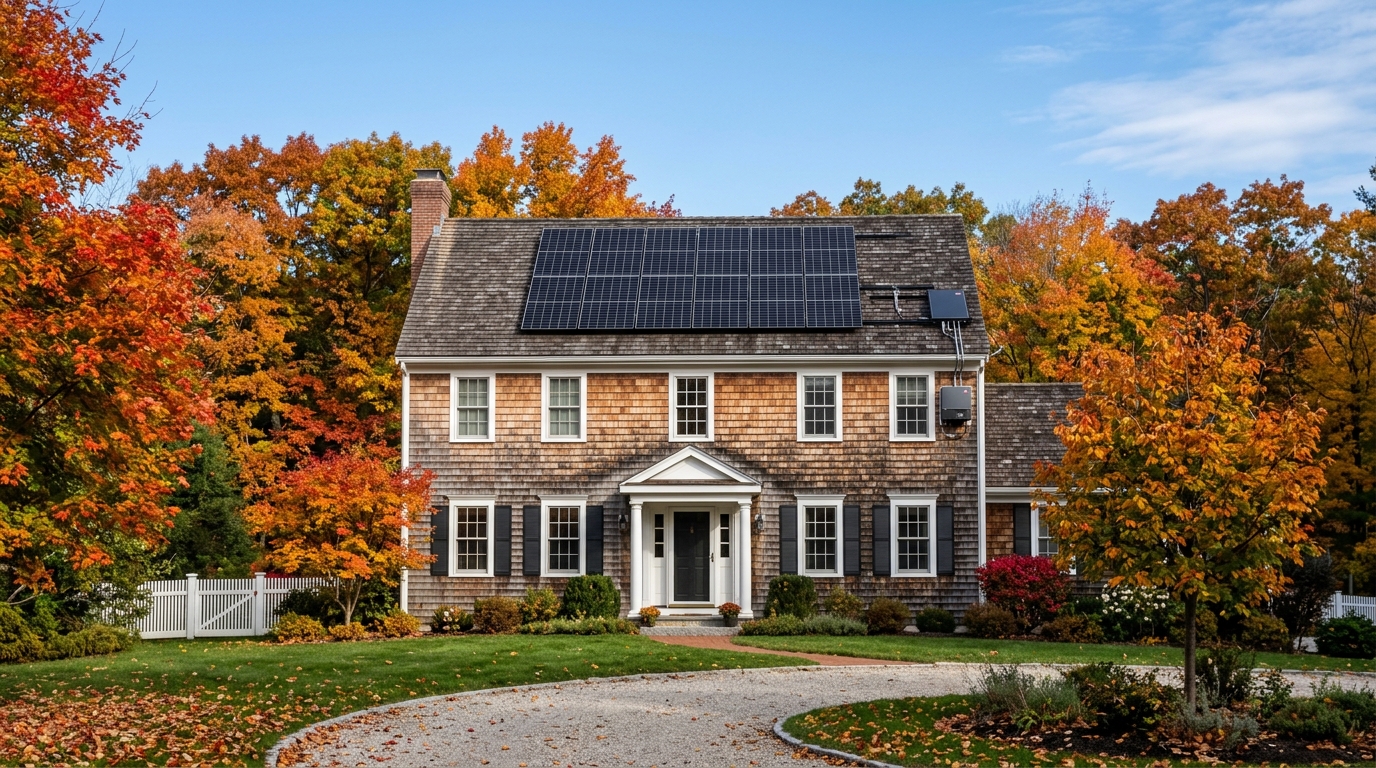
Massachusetts has mediocre sun (3.8-4.3 peak hours/day) but the most aggressive state-level solar policy stack in the U.S.: the federal 30% credit, the Solar Massachusetts Renewable Target (SMART) declining-block incentive paying $0.04-$0.30/kWh of generation for 10 years, full retail-rate net metering with Eversource and National Grid, a state income-tax creditof 15% (capped at $1,000), and a property-tax exemption. Result: 2026 MA solar payback runs 5-8 years — among the fastest in the nation, sun resource be damned.
The 2026 Massachusetts solar baseline (typical 8 kW system)
- Gross cost (before incentives): $19,200-$26,400 ($2.40-$3.30 per watt).
- Federal tax credit (30% §25D): reduces cost by $5,760-$7,920.
- MA state income tax credit (15%, cap $1,000): additional $1,000 off.
- Net cost after federal + state credits: $12,440-$17,480.
- SMART block income (over 10 yrs): ~$4,000-$8,500 cumulative on 8 kW depending on block + utility.
- Typical payback period: 5-8 years.
State-adjusted by system size and roof type: Massachusetts solar cost calculator.
SMART Program — the declining-block incentive that decides your payback
SMART pays a fixed per-kWh incentive on every kWh your system generates, for 10 years from commissioning. The rate declines as more solar capacity is added in your utility's territory:
- Eversource (East/West): currently in late SMART blocks; expect $0.06-$0.12/kWh in 2026.
- National Grid: similar trajectory, $0.04-$0.10/kWh in 2026.
- Unitil: highest residual rates — typically $0.10-$0.18/kWh in 2026.
- Adders: low-income, brownfield, agricultural, and pollinator-friendly siting can add $0.02-$0.06/kWh on top.
Translation: the SMART signup date matters more than almost any other variable. Each block fills faster than expected as solar adoption accelerates — apply within days of contract signing, not weeks.
Net metering: full retail-rate, with caveats
Massachusetts has full 1:1 net metering for residential systems under 10 kW (Class I), with excess credits rolling forward indefinitely on Eversource and National Grid. Larger residential systems (10-25 kW) get retail-rate net metering but cap utility-level capacity — most ISOs are at or near cap in 2026, so larger installs may face waitlists or accept Alternative On-Bill Credit at a slight discount.
Three Massachusetts-specific cost drivers
- Boston-metro skilled-trade premium. Suffolk, Middlesex, Norfolk, and Essex counties pay solar installer labor 18-25% above national rates — competes with Boston construction wages.
- Historic-district preservation review. Pre-1900 housing stock in Cambridge, Boston, Salem, and Newburyport triggers historical commission review; panel-color and roof-line restrictions can add $400-$1,500 to system design.
- Snow + ice loading. Western and Berkshire MA require 50-70 psf snow-rated racking; expect $400-$900 surcharge vs. standard 30-40 psf systems.
The bottom line for Massachusetts homeowners
Massachusetts solar in 2026 is a top-3 U.S. investment, alongside New Jersey and (for legacy NEM-1 customers) California. The SMART program income tail — $400-$850/year for 10 years on a typical 8 kW system — is what pushes payback under 6 years despite the sun being weaker than Texas or Florida. Commission before the next SMART block fills. Run our Massachusetts solar cost calculator, then collect three written bids from NABCEP-certified installers and confirm SMART block eligibility in writing.
More cost guides for Massachusetts
Planning multiple projects? Every other 2026 Massachusetts cost guide carries the same state-specific labor and pricing detail.
- Cost GuideBasement Finishing Cost in Massachusetts 2026
- Cost GuideBathroom Remodel Cost in Massachusetts 2026
- Cost GuideDeck Construction Cost in Massachusetts 2026
- Fence InstallationFence Installation Cost in Massachusetts 2026 — Wetland Setbacks, Labor & Material Guide by Metro
- Cost GuideFlooring Installation Cost in Massachusetts 2026
- FurnaceFurnace Cost in Massachusetts 2026 — Oil-to-Heat-Pump Conversion Math + Mass Save 75-100% Stack
- Cost GuideHardscape Installation Cost in Massachusetts 2026
- Cost GuideIn-Ground Pool Installation Cost in Massachusetts 2026
- InsulationInsulation Cost in Massachusetts 2026 — The Mass Save 75-100% Rebate Playbook
- Cost GuideKitchen Remodel Cost in Massachusetts 2026
- Cost GuideLandscaping Cost in Massachusetts 2026
- Cost GuidePainting Cost in Massachusetts 2026
- Cost GuideRoof Replacement Cost in Massachusetts 2026
- Window ReplacementWindow Replacement Cost in Massachusetts 2026
Cost by state for this project
State-adjusted ranges with local labor and material multipliers.
Keep reading
From the pillar series
See how your state ranks for 2026 solar payback →
All 50 US states ranked by payback years on the same $200/mo baseline. Hawaii 3.1 yr, MA 3.7 yr, CT 4.1 yr down to ND 11.5 yr.
See the 50-state ranking →