Solar Panels
Solar Panel Cost in Nevada 2026 — NV Energy, Excess Energy Credits & Vegas Heat-Derate
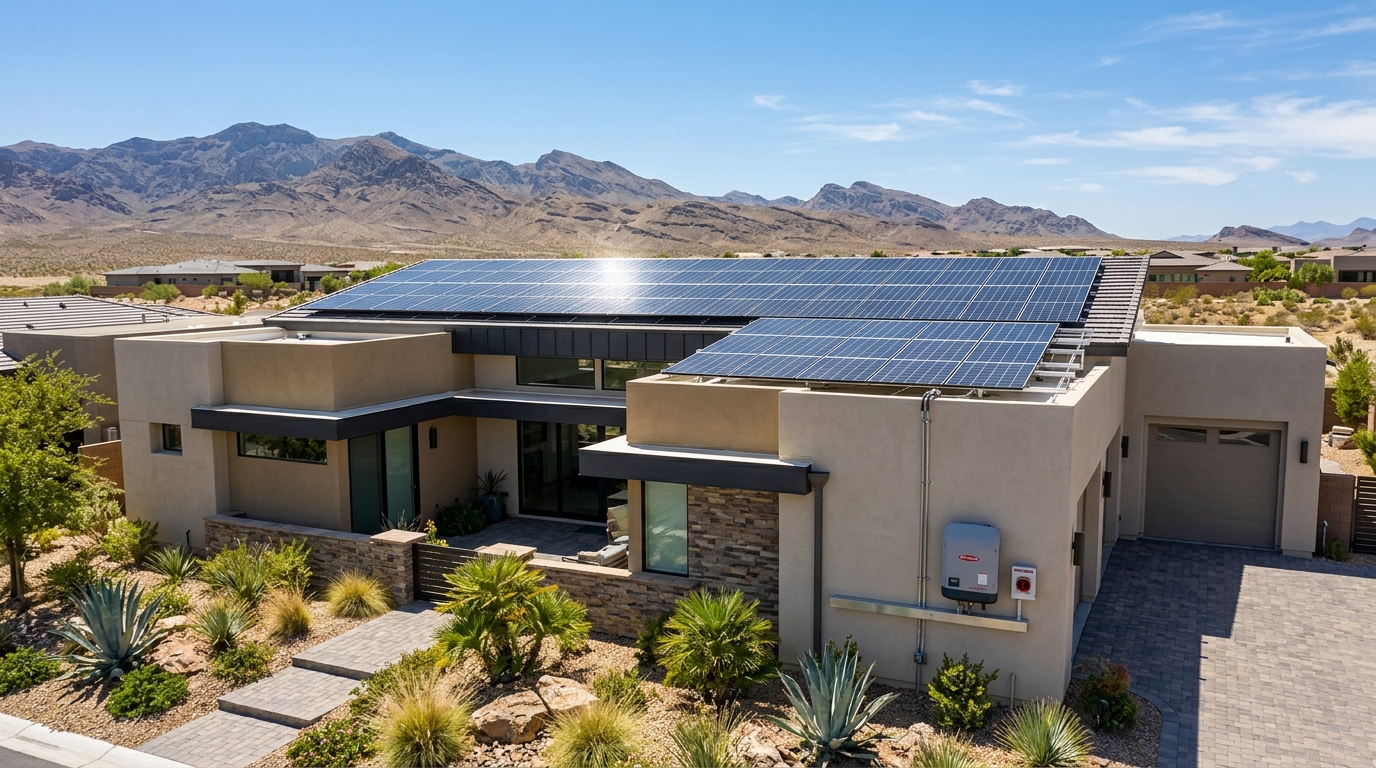
Nevada has the second-best sun resource in the country (5.8-6.4 peak sun hours/day in Las Vegas) and one of the more painful rate-structure stories in the West. NV Energy ended retail-rate net metering in 2017 and now compensates exported solar at roughly 75% of retail for new "NEM 2.0" customers — well above California's NEM 3.0 cliff, but still a real haircut. Add the brutal summer heat-derate (panels run 15-22% below rated output at 110°F+ ambient) and you get 2026 payback periods of 7-11 yearsacross most of southern Nevada — fastest with a battery, slowest if you over-size.
The 2026 Nevada solar baseline (typical 8 kW system)
- Gross cost (before incentives): $13,200-$19,800 ($1.65-$2.48 per watt).
- Federal tax credit (30% §25D): reduces cost by $3,960-$5,940.
- Net cost after federal credit: $9,240-$13,860.
- With battery added (10 kWh): add $8,500-$13,000 gross / $5,950-$9,100 net.
- Typical payback period: 7-11 years (best with NV Energy TOU + 13.5 kWh battery shifting export to evening peak).
State-adjusted by system size and roof type: Nevada solar cost calculator.
NV Energy's "Excess Energy Credits" — the rate-structure that decides payback
Nevada's compensation system isn't net metering. New 2026 customers fall under NEM 2.0 with tiered Excess Energy Credit rates that decline as more solar capacity is added statewide:
- You import: retail rate (typically $0.10-$0.16/kWh depending on TOU period).
- You export: credited at ~75% of retail (the current Tier 3 rate) — roughly $0.075-$0.12/kWh.
- Net effect: exported energy is worth less than imported energy, so battery storage (self-consumption) materially improves economics over export-only systems.
The southern Nevada heat-derate (it's bigger than you'd guess)
Solar panels are rated at 25°C cell temperature, but Las Vegas roof panels routinely hit 65-75°C in July-August. Standard mono PERC panels lose ~0.35% per °C above 25°C — so a panel running at 70°C is producing 15.75% below rated. Net annual production typically lands 12-18% below STC nameplate in Clark County, vs. 5-8% derate in cooler climates like Reno. Practical implication: size to real kWh output, not nameplate watts. A 10 kW "nameplate" system in Henderson realistically delivers 14,500-15,500 kWh/year, not 17,000.
Three Nevada-specific cost drivers
- Las Vegas tourism-industry labor competition. Casino construction and hospitality-build pull skilled trade labor away from residential solar installers during peak summer, pushing labor day-rates 8-15% higher than statewide averages.
- Tile roof attachment surcharge. Concrete-tile roofs (common on Henderson/Summerlin builds 1995-2015) require special hooks and flashings; expect a $400-$900 surcharge on a typical install vs. asphalt-shingle.
- NV Energy interconnection wait. 4-8 week timelines in Clark County for permission-to-operate (PTO) approvals in 2026; some installers offer "PTO acceleration" paperwork add-ons for ~$200.
The bottom line for Nevada homeowners
Nevada solar in 2026 is a strong-but-not-California-grade investment. Pair an 8 kW array with a 10-13.5 kWh battery, oversize the array 10-15% to compensate for heat-derate, and you'll hit payback in 7-9 years on NV Energy. Run our Nevada solar cost calculator for a system-sized estimate, then collect three written bids from NABCEP-certified installers.
More cost guides for Nevada
Planning multiple projects? Every other 2026 Nevada cost guide carries the same state-specific labor and pricing detail.
- Cost GuideBasement Finishing Cost in Nevada 2026
- Cost GuideBathroom Remodel Cost in Nevada 2026
- Cost GuideDeck Construction Cost in Nevada 2026
- Fence InstallationFence Installation Cost in Nevada 2026 — HOA Reality, Labor & Material Guide by Metro
- Cost GuideFlooring Installation Cost in Nevada 2026
- Cost GuideHardscape Installation Cost in Nevada 2026
- Cost GuideIn-Ground Pool Installation Cost in Nevada 2026
- Cost GuideKitchen Remodel Cost in Nevada 2026
- Cost GuideLandscaping Cost in Nevada 2026
- Cost GuidePainting Cost in Nevada 2026
- Cost GuideRoof Replacement Cost in Nevada 2026
- Window ReplacementWindow Replacement Cost in Nevada 2026 — Las Vegas Sun, Reno's Mountain Climate, NV Energy Rebates
Cost by state for this project
State-adjusted ranges with local labor and material multipliers.
Keep reading
From the pillar series
See how your state ranks for 2026 solar payback →
All 50 US states ranked by payback years on the same $200/mo baseline. Hawaii 3.1 yr, MA 3.7 yr, CT 4.1 yr down to ND 11.5 yr.
See the 50-state ranking →