Cost Guide
Window Replacement Cost Guide 2026 — All Materials Compared
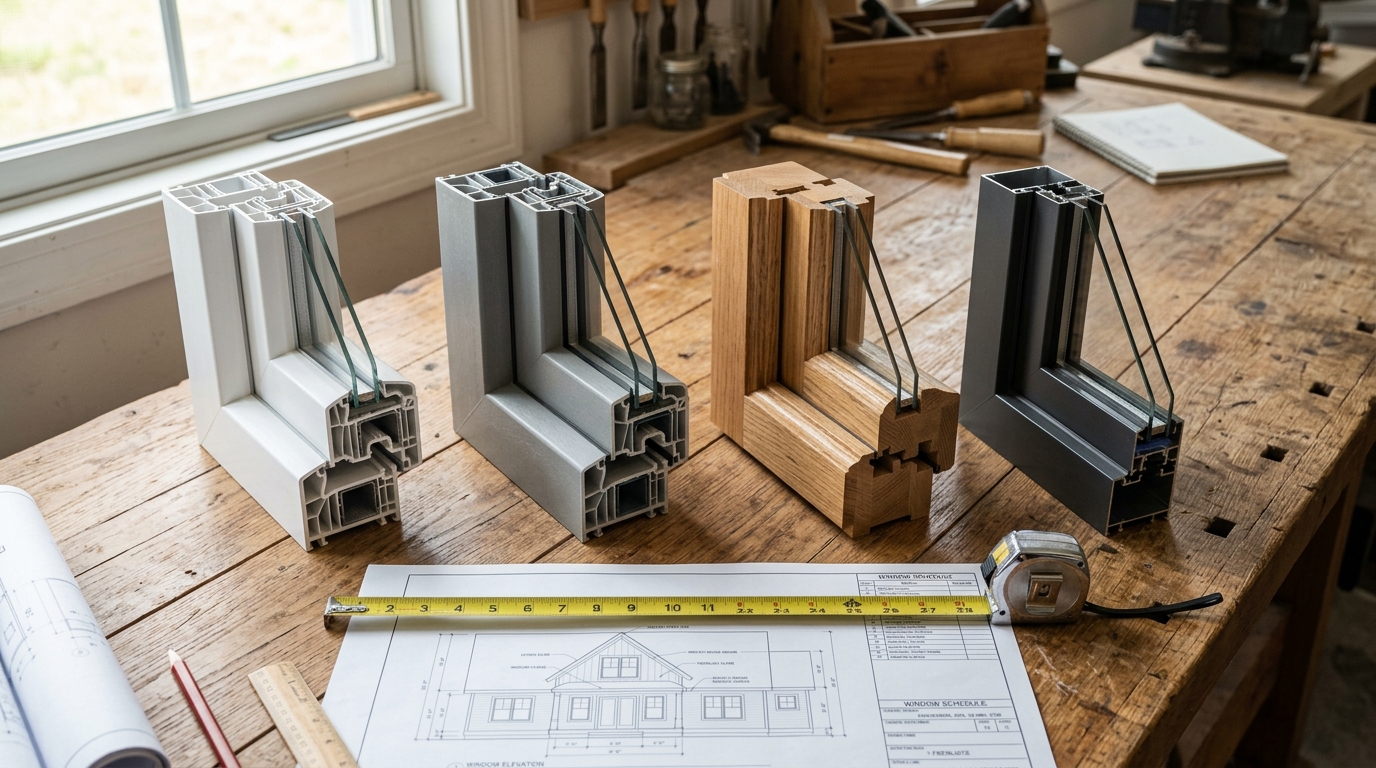
Window replacement is one of the few major home projects where the cheapest material can be the right material — and the most expensive can be the worst fit. Vinyl gets unfairly maligned, wood gets unfairly glamorized, fiberglass is overlooked, and aluminum is wrong for almost everyone outside the Florida HVHZ. Here's the complete 2026 guide to what window replacement actually costs across every material, operating style, and climate — built from real installer pricing, not catalog list prices.
The 2026 cost-per-window benchmarks
Across the U.S. in 2026, installed cost per window (mid-range quality, double-hung, average size 36"×60", national average — not specific to high-cost states):
| Material | Installed $ per window | Lifespan | Best fit |
|---|---|---|---|
| Vinyl (standard) | $450–$900 | 25–35 yrs | Most U.S. homes; best $/value |
| Vinyl (premium, multi-chamber) | $650–$1,200 | 30–40 yrs | Cold climates, energy-focus |
| Vinyl (impact-rated) | $900–$1,800 | 25–35 yrs | FL, coastal Gulf/Atlantic |
| Aluminum (standard) | $550–$1,100 | 20–30 yrs | Mild climates only |
| Aluminum (impact-rated, HVHZ) | $1,400–$2,800 | 25–35 yrs | FL Miami-Dade / Broward |
| Fiberglass | $900–$1,800 | 40–50 yrs | Best long-term value; cold climates |
| Composite (Andersen Fibrex, etc.) | $1,000–$2,000 | 35–50 yrs | All climates; mid-premium tier |
| Wood (clad exterior) | $1,200–$2,400 | 30–60 yrs | Historic homes; aesthetics-driven |
| Wood (full wood, traditional) | $1,500–$3,200 | 30–80 yrs with maintenance | Historic restoration |
Multiply per-window numbers by your window count. A typical 12–15 window home in the U.S. runs $7,000–$30,000 depending on material and quality tier. Run our window replacement calculator for a state-adjusted estimate.
The 4 decisions that drive 80% of your project cost
Decision 1 — Material
The single biggest cost lever. Here's the honest take on each:
Vinyl — the right answer for most U.S. homes
Modern multi-chamber vinyl windows (Andersen 100, Pella 250, Marvin Elevate vinyl line) deliver U-factor values of 0.25–0.30, lifespans of 30+ years, and per-window costs 30–50% below fiberglass for nearly identical real-world performance. The "vinyl looks cheap" critique is outdated — modern vinyl extrusions have crisp profiles, real exterior color matching, and weld lines that disappear behind trim.
Aluminum — almost always wrong unless you're in Florida HVHZ
Aluminum conducts heat. Standard aluminum windows in any cold-climate state lose energy at 3–4× the rate of vinyl or fiberglass. The exception: Florida's High Velocity Hurricane Zone (Miami-Dade, Broward), where impact-rated aluminum windows perform identically to impact-rated vinyl in code testing and are sometimes spec'd by structural engineers for very large openings (over 60" wide) where vinyl flexes. Outside Florida, skip aluminum.
Fiberglass — the best long-term value
Fiberglass windows (Marvin Integrity, Pella Impervia, Andersen 400/A-Series) have the lowest expansion/ contraction coefficient of any window material — meaning they don't warp, sag, or stress glass seals over time. Lifespan of 40–50 years is genuinely realistic. Higher upfront cost but the lowest total cost of ownership in most cold-climate scenarios.
Composite (Andersen Fibrex) — premium without the wood maintenance
Andersen's Fibrex (40% wood fiber + 60% thermoplastic) sits between fiberglass and clad-wood in positioning. Real benefit: thinner sightlines than vinyl, no exterior painting ever, ~40-year lifespan. Cost premium over premium vinyl: ~25%. Worth it if sightlines matter to you (historic home, modern architecture, large picture windows).
Wood (clad-exterior) — for historic homes only
Clad-exterior wood (aluminum or fiberglass cladding over a wood interior) is the right answer for two scenarios: (1) historic homes where the original wood interior aesthetic matters, (2) very high-end homes where wood is the design language. Otherwise, you're paying a 50–80% premium over fiberglass for a comparable real-world performance metric. Real full-wood windows (no exterior cladding) require repainting every 5–7 years — a real cost most homeowners forget.
Decision 2 — Operating style
How a window opens matters more than people realize — both for cost and for performance:
- Fixed (picture): $50–$150 lower than equivalent operable. Best energy performance (no air-leak path).
- Casement: baseline cost. Best ventilation (full sash opens). Best air-seal among operable windows. Best for cold climates.
- Double-hung: +5–10% over casement at the same brand/material. Traditional aesthetic. Worst air-seal of common styles.
- Slider (horizontal): -5–10% under casement. Worst energy performance among operable styles.
- Awning: baseline-similar cost. Best for bathrooms/kitchens (opens out and up; rain-resistant when open).
- Bay/bow: 3–5× single-window cost. Counts as ~3 windows installed.
Decision 3 — Glass package
The most over-spec'd category in the entire window industry. Don't pay for premium glass you don't need:
- Standard low-E + argon, double-pane: the right answer for 80% of U.S. homes. U-factor 0.27–0.30. Roughly $80–$160 cost over clear single-pane glass per window.
- Triple-pane + krypton: meaningful improvement only in cold climates (zones 6+, northern Midwest, New England, mountain states). Adds ~$120–$300 per window. In warm climates (FL/TX/CA), the energy ROI is essentially zero — don't pay for it.
- Tinted / heat-reflective glass: useful in cooling-dominated climates (FL, AZ, TX, southern CA). Adds $40–$120 per window. Real cooling savings of 5–10%.
- Laminated (security/sound): useful for ground-floor street-facing windows in noisy urban locations. Adds $150–$400 per window. Cuts traffic noise by 6–10 dB.
Decision 4 — State and labor market
The same 14-window home swings from $8,400 in Mississippi or West Texas to $24,000 in coastal California or the New York metro. State multipliers vs. the U.S. national average:
- High-cost (CA, NY, MA, CT, NJ, HI): 1.4× national average
- Florida HVHZ (Miami-Dade, Broward): 1.25× (NOA product premium)
- Mid-high (WA, CO, OR, IL Chicago, MD): 1.15×
- Baseline (TX, FL non-HVHZ, AZ, NC, GA, OH): 1.0×
- Low (MS, AR, OK, KS, NE, IA, AL, WV): 0.82–0.88×
Full project cost breakdown — typical 14-window mid-range install
For a 14-window premium vinyl install at U.S. national average pricing, total $13,400:
- Materials (50%): $6,700 — 14 windows at ~$480/window average
- Labor (35%): $4,690 — crew (2–3 days for 14 windows), trim/finish, sealing
- Permits & fees (5%): $670 — building permit, 1–2 inspections
- Contingency (10%): $1,340 — rotted frame replacement, stucco/siding repair, oversized opening adjustments
The energy ROI math — does it actually pay back?
Most "energy savings" marketing from window manufacturers is misleading. Here's the honest 2026 math:
- Replacing single-pane wood/aluminum with modern double-pane low-E: typical annual energy savings $250–$500 in cold climates, $150–$350 in mild climates. Payback period: 25–40 years.
- Replacing existing double-pane (1990s vintage) with current double-pane: typical annual savings $50–$150. Payback period: longer than the window's lifespan. Energy alone is not the right reason to replace.
- Real reasons to replace existing double-pane: failed seals (fogging between panes), broken sashes, rotted frames, single-pane combined with aesthetic update, or storm protection upgrades in coastal markets.
Regional climate fit — what to actually buy
Cold climates (Northeast, Midwest, Mountain West)
Recommendation: Premium vinyl or fiberglass. Triple-pane + krypton if you're heating with electric resistance or have above-average ceiling height. Casement operating style for best air-seal.
Hot/humid climates (FL, TX Gulf, southeast)
Recommendation: Standard double-pane with low-E + argon + tint. Skip triple-pane (no meaningful return). Impact-rated required in coastal Florida (see our Florida windows guide).
Mild climates (coastal CA, Pacific Northwest)
Recommendation: Standard vinyl with low-E + argon. No tint needed for cooling. No triple-pane needed for heating.
Hot/dry climates (AZ, NM, inland CA, NV)
Recommendation: Vinyl with strong heat-reflective tint + low solar heat gain coefficient (SHGC under 0.25). UV protection matters a lot here.
Permits and warranties
Almost every U.S. municipality requires a permit for window replacement (Florida is the strictest; most others require a permit only when the opening size changes or structural framing is affected, but many require for any replacement). Permits run $150–$600.
Warranties to look for in 2026:
- Frame: 20-year minimum (transferable to next owner ideally)
- Glass seal: 20-year minimum (this is the #1 long-term failure mode)
- Hardware: 10-year minimum on casement/awning operating mechanisms
- Installation: 5-year minimum from your installer (separate from manufacturer warranty)
The 6 questions to ask any window contractor before signing
- What's the U-factor and SHGC of the specific glass package you're quoting?
- Is the frame warranty transferable to a future buyer of my home?
- What's your installation warranty (separate from manufacturer)?
- Are you including new exterior trim/wrap or reusing the existing? (Major aesthetic and weatherproofing detail.)
- How do you handle openings that turn out to have rotted framing during demo?
- Are you using foam or fiberglass batt around the window? (Spray foam is better; ask which.)
FAQ
How much does it cost to replace windows in 2026?
$450–$1,800 installed per window depending on material, with U.S. national average around $650 for premium vinyl, $1,300 for fiberglass, $1,500 for wood-clad. Typical 12–15 window home runs $7,000–$30,000.
Is vinyl or fiberglass the better window material in 2026?
Vinyl is the right answer for most U.S. homes (best $/value, 30+ year lifespan, modern aesthetics). Fiberglass wins on long-term durability and is the better choice in extreme cold climates or for very large openings. The price gap is typically 60–80% — fiberglass is meaningfully more expensive upfront.
Should I get triple-pane windows?
Only in cold climates (IECC zones 6+ — northern Midwest, New England, Mountain West, Alaska). In mild and warm climates, triple-pane delivers minimal energy savings over double-pane while costing 25–40% more. Most U.S. homeowners are better served by quality double-pane with proper low-E coatings.
Run a personalized estimate
Get a state-adjusted window replacement cost estimate in under 60 seconds: window replacement calculator. Want a state-specific deep dive? Try the Florida windows guide.