Fence Buyer's Guide
Wood vs Vinyl Fence: Which Pays Off Long-Term? (2026 Cost & Lifespan)
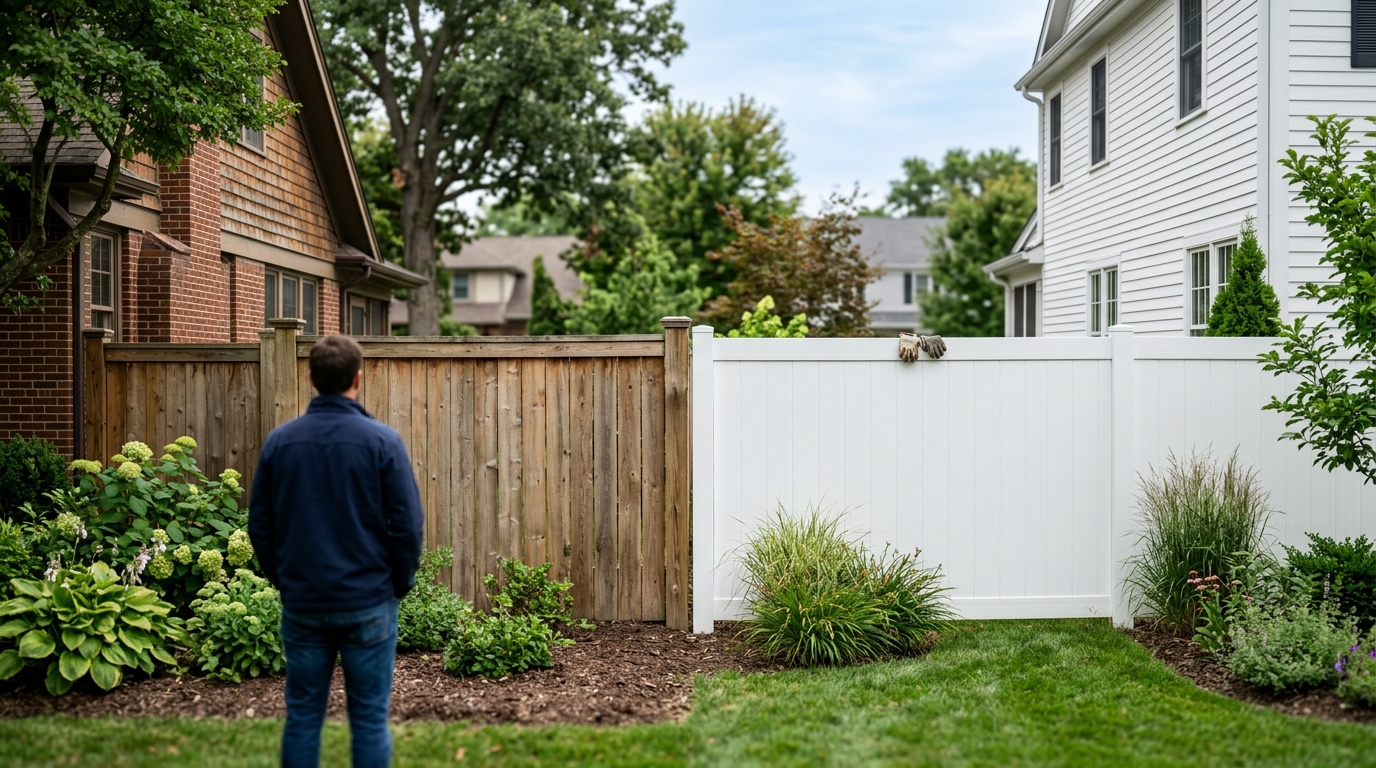
Wood and vinyl are the two materials in 90%+ of U.S. residential privacy fence decisions in 2026. Wood is cheaper upfront — but vinyl is dramatically cheaper to own. Here's the honest 30-year cost math, where each material clearly wins, and the climate factor that flips the answer in cold or coastal regions.
The 2026 upfront cost gap
- Pressure-treated pine fence: $18–$30 per linear foot installed
- Western red cedar fence: $25–$45 per linear foot installed
- Standard vinyl (PVC) fence: $25–$50 per linear foot installed
- Premium vinyl (thicker walls, ribbed posts): $40–$60 per linear foot installed
For a typical 150-foot backyard perimeter at 6 feet tall:
- Pressure-treated wood: $2,700–$4,500
- Cedar: $3,750–$6,750
- Standard vinyl: $3,750–$7,500
- Premium vinyl: $6,000–$9,000
At the budget end (pressure-treated pine vs standard vinyl), vinyl costs roughly 25–40% more. At the mid tier (cedar vs standard vinyl), they're nearly identical. The upfront cost gap is much smaller than most homeowners assume.
Lifespan and replacement: where the real gap lives
- Pressure-treated pine: 10–15 year lifespan. Then full replacement.
- Western red cedar: 15–25 year lifespan with proper staining every 3–4 years. Then full replacement.
- Standard vinyl (PVC): 25–40 year lifespan. No replacement required in most homeowners' tenure. UV-stabilized; doesn't rot, warp, or split.
- Premium vinyl: 35–50+ year lifespan with manufacturer's lifetime warranty (transferable to next owner — meaningful at resale).
Translation: a homeowner staying 25 years in a property typically pays for 2 wood fences in the timespan of 1 vinyl fence. Replacing a 150-foot fence at $3,000–$6,750 in cost-of-future dollars eliminates the upfront savings entirely.

A typical cedar privacy fence — beautiful at year 1, requires staining every 3–4 years to keep it that way. Without maintenance, expect significant gray-out and warping within 5–7 years.
Maintenance: the hidden cost most homeowners forget
- Pressure-treated pine: Stain or seal every 3–4 years. Cost: $1.50–$3.00/sq ft DIY, $3–$5/sq ft hired. For a 6'×150' fence = 900 sq ft × $3 = ~$2,700 every 3–4 years. Over 30 years: 7–10 maintenance cycles, $18,000–$25,000 in staining alone.
- Cedar: Similar staining cadence but accepts stain more readily — slightly less labor. Over 30 years: $15,000–$22,000 in staining.
- Vinyl: Annual rinse with a garden hose. Pressure wash every 3–5 years ($200–$400 hired, DIY for free). Over 30 years: $1,500–$4,000 in total maintenance.
This is the line item where wood loses decisively. The cost of keeping a wood fence looking like new over 25 years is 5–10× the cost of keeping a vinyl fence looking the same.
30-year total cost of ownership
Install + replacement(s) + maintenance, for a 150-foot residential fence:
- Pressure-treated pine: $2,700 (install) + $3,500 (replacement at year 12) + $20,000 (staining) = $26,200
- Cedar: $5,000 (install) + $6,500 (replacement at year 20) + $18,000 (staining) = $29,500
- Standard vinyl: $5,500 (install, lasts 30 years) + $2,500 (washing/repair) = $8,000
- Premium vinyl: $7,500 (install, lasts 40+ years) + $2,500 (washing/repair) = $10,000
Over 30 years, vinyl costs less than half what wood costs. The "upfront premium" of vinyl pays back in roughly 6–9 years — well before either wood option needs replacement.
When wood is still the right call
- Selling in < 5 years. If you won't recoup the maintenance gap or experience the replacement cycle, the upfront savings of wood is real money in your pocket.
- Architectural fit. Some historic neighborhoods, mid-century homes, and rustic properties look wrong with vinyl. Vinyl reads as "suburban developer" in many architectural contexts.
- Custom build or atypical shape. Hand-built picket fences, lattice tops, asymmetrical designs — wood gives you near-unlimited customization. Vinyl is panel-based and limits you to manufacturer configurations.
- Stain-able or paint-able to match home. Wood lets you change color over its life. Vinyl comes in 4–8 factory colors, and that's it.
- HOA requires natural materials. Some HOAs explicitly disallow vinyl. Check the CC&Rs before pricing.
The climate factor that changes the math
- Hot, dry climates (AZ, NV, NM, west TX, southern CA inland): Vinyl can become brittle under sustained 110°F+ heat with UV exposure — particularly cheaper, non-UV-stabilized brands. Stick to premium UV-stabilized vinyl (Bufftech, ActiveYards, CertainTeed) or pick cedar.
- Cold climates with deep frost (MN, ND, WI, ME, upstate NY): Frost heave is a fence killer. Both wood and vinyl need posts set 36–48" deep with concrete. Vinyl posts are more rigid and handle freeze-thaw better than wood, which can rot at the ground contact point.
- Coastal salt-air climates (FL, coastal CA, Outer Banks, Gulf Coast): Vinyl wins by a wide margin. Wood requires constant re-treatment to fight salt corrosion and fungal rot. Pressure-treated pine often degrades to "replace" condition within 8 years in salt-air zones.
- Wildfire-prone areas (CA WUI, OR, WA, CO, AZ): Some jurisdictions ban combustible fencing within 5 feet of structures. Vinyl is not officially "non-combustible" but is far more resistant than wood. Check local fire code (especially CA WUI Zone 0).
The honest bottom line
For roughly 75% of U.S. homeowners staying in their home 8+ years, vinyl is the clear long-term winner. The 25–40% upfront premium pays back in maintenance avoidance within 6–9 years, then delivers another 20+ years of essentially-free fence.
The exceptions: homeowners selling within 5 years, owners who specifically want the architectural look of natural wood, and properties where HOAs or custom shapes force the issue. In those cases, cedar (not pressure-treated pine) is the smarter wood pick — better longevity, takes stain better, looks materially better than pine.
Run your specific numbers:
- Fence installation cost calculator — wood, vinyl, chain-link, aluminum, and composite with state-adjusted pricing
- How to finance a home renovation — financing options for a $3–$15k fence project
- Why renovation costs differ by state
Sources: American Fence Association 2026 industry survey, Bureau of Labor Statistics regional labor data, manufacturer warranty data from CertainTeed, Bufftech, and ActiveYards, and contractor pricing data from a 2025–26 national sample of U.S. fence installers.