Hiring
Hiring a Contractor: A Homeowner's Checklist
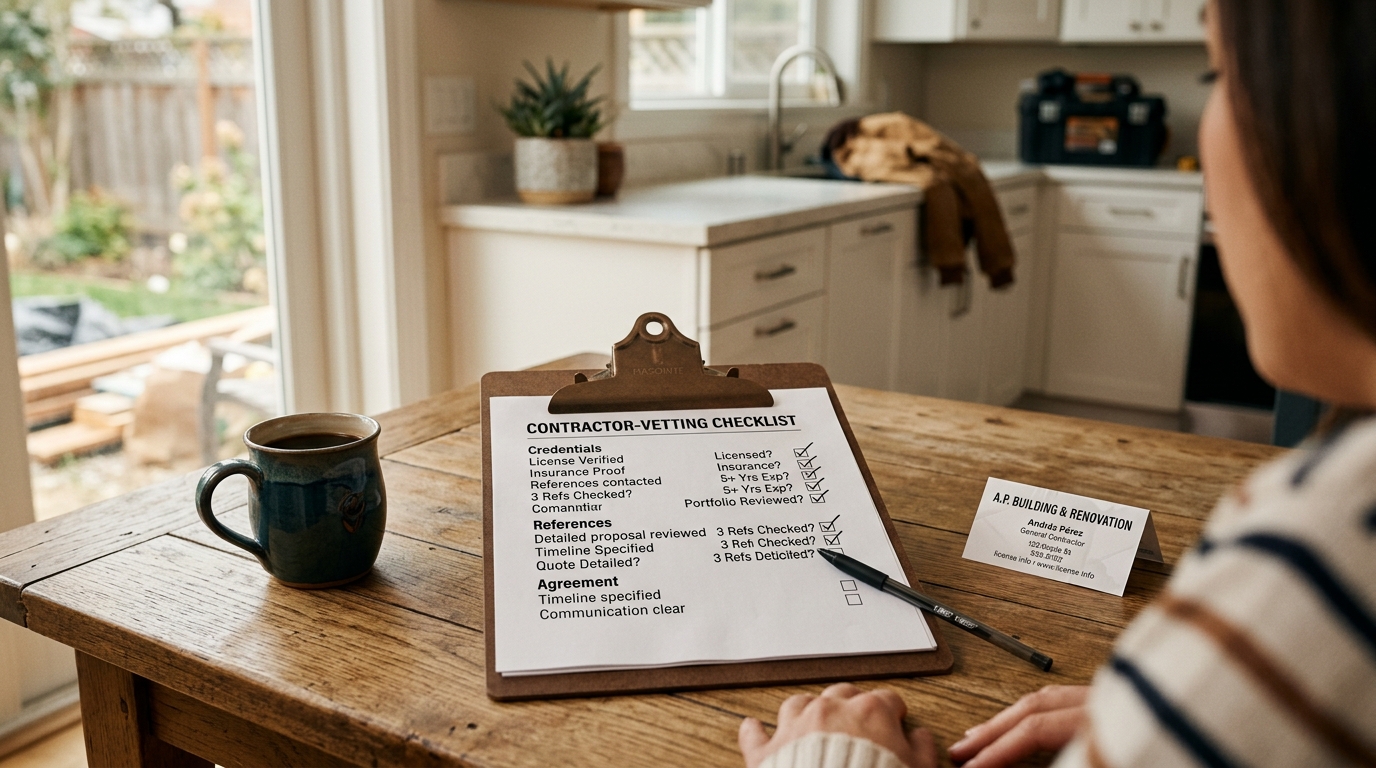
The biggest variable in any home renovation isn't materials, design, or even your budget. It's the contractor. A great contractor finishes on schedule, communicates proactively, and makes the project feel almost easy. A bad one drags timelines, cuts corners, and disappears mid-job. The vetting work below takes 4–6 hours total and will save you tens of thousands of dollars and months of regret.
Before getting quotes, use our free home renovation calculators to understand fair pricing in your state. You'll walk into bid conversations knowing what reasonable looks like — and what doesn't.
Step 1: Generate at least three real quotes
"Real" means: based on a site visit, an itemized scope, and the same product specs. Quotes from contractors who never visited your home, or who only quoted total project cost without breakdown, are unusable for comparison.
Get the first contractor's itemized quote, then send the same scope and product list to the next two. This forces apples-to-apples pricing. Without it, you're comparing a contractor who priced premium tile against one who priced budget tile, and the lower number always wins for the wrong reason.
Need a fast way to baseline what fair pricing looks like? Run our bathroom, kitchen, flooring, or roofing calculator first. Quotes more than 30% above that range warrant pushback; quotes more than 25% below it warrant suspicion.
Step 2: Verify license, insurance, and bond
Before any quote conversation, ask the contractor for:
- State contractor's license number. Verify it directly on your state's licensing board website. Confirm the name on the license matches the company you're hiring.
- General liability insurance. Minimum $1M coverage. Ask for a Certificate of Insurance — not a screenshot. Real ones are issued by the insurer.
- Workers' compensation insurance. If the contractor has employees and isn't carrying workers' comp, you can be held liable for on-site injuries.
- Surety bond. Some states require it. Verify the amount and issuer.
Any pause, evasion, or "I'll send it later" on these is a red flag. Reputable contractors send all four within 24 hours.
Step 3: Reference checks that actually matter
Most homeowners ask for references and never call them. The references that matter aren't the recent happy ones — they're projects from 2–4 years ago. That's where you find out:
- Has the work held up?
- Did warranty issues get handled?
- Did the contractor return calls a year later?
Ask for at least three references with completion dates 18+ months ago. Call all three. The five questions:
- Did the project finish on the original timeline?
- Did the final cost match the original quote? If not, by how much and why?
- Were there any change orders, and how were they handled?
- How was communication during the project?
- Would you hire them again? (The most important question — listen to the pause before the answer.)
Step 4: Read the contract before you sign
A real contract from a reputable contractor includes all of the following:
- Detailed scope of work. Itemized — not "remodel the bathroom" but each task, each fixture, each finish.
- Specific products and finishes. Brand + model + finish + quantity. "Allowance" line items mean the price floats on what you actually pick — get those allowances explicit.
- Start date and substantial completion date. With per-day delay penalties for missed deadlines.
- Payment schedule tied to milestones. Never more than 10% upfront. Subsequent payments tied to demo complete, rough-in inspected, drywall closed, etc.
- Lien waivers. Conditional waivers from each subcontractor at each payment. Final unconditional waivers at completion.
- Change-order process. Written, signed by both parties, priced before work proceeds. No verbal change orders.
- Warranty. 1 year minimum on labor, manufacturer warranty pass-through on materials.
- Termination clause. Both parties' rights if the project goes sideways.
Red flags — walk away if you see any of these
- Asks for more than 10% upfront, or for full payment in cash
- Refuses to pull permits or asks you to pull them instead
- No physical business address; only a cell phone number
- Won't provide a written itemized quote
- Pressure to sign today (offers a "discount" that expires)
- Materially below the other two quotes (often signals plans to upcharge via change orders)
- License or insurance documents take more than 24 hours to send
- References that all completed in the last 6 months (no track record)
Payment schedule that protects you
A reasonable schedule for a $20,000 bathroom remodel:
- 10% deposit at contract signing ($2,000)
- 20% at demo + rough-in start ($4,000)
- 30% at rough-in inspection passed ($6,000)
- 30% at final inspection passed ($6,000)
- 10% retention released after punch list complete ($2,000)
That last 10% retention is the single most important leverage you have. Never release it before the punch list is fully closed. A contractor who insists on 100% payment at substantial completion is not a contractor you want.
Cost data sourced from the 2026 Remodeling Magazine Cost vs Value Report, Bureau of Labor Statistics regional labor data, and contractor pricing surveys.
What to do if it goes sideways
If problems develop mid-project:
- Document everything in writing immediately. Email beats text beats verbal — every time.
- Pause additional payments until the issue is resolved.
- Bring in a third-party home inspector ($300–$600) for a written assessment of any disputed work.
- If the contractor walks off, file a complaint with your state licensing board and your AG's consumer-protection office before they shut down and reincorporate under a new name.
Bottom line
Cheap contractors are expensive. Spend the 4–6 hours upfront on vetting and references, sign a real contract, and stage payments to milestones. Do that and 90% of the contractor-renovation horror stories simply don't happen to you. Start with state-specific cost ranges from our calculators so you walk into bid conversations knowing what fair pricing looks like.
More cost guides for California
Planning multiple projects? Every other 2026 California cost guide carries the same state-specific labor and pricing detail.
- Cost GuideBasement Finishing Cost in California 2026
- Cost GuideBathroom Remodel Cost in California 2026
- Cost GuideDeck Construction Cost in California 2026
- Fence InstallationFence Installation Cost in California 2026 — WUI Fire Rules, Labor Premium & HOA Reality
- Cost GuideFlooring Installation Cost in California 2026
- Cost GuideHardscape Installation Cost in California 2026
- HVACHVAC Cost in California 2026 — Title 24, Heat-Pump Mandate, and the True Cost After TECH Rebates
- Pool InstallationIn-Ground Pool Cost in California 2026 — Why CA Pools Cost 30-45% More
- PaintingInterior & Exterior Painting Cost in California 2026 — Why CA Painting Runs 25-40% More
- Cost GuideKitchen Remodel Cost in California 2026
- Cost GuideLandscaping Cost in California 2026
- Solar Buyer's GuideNEM 3.0 Explained for California Homeowners (2026)
- RoofingRoof Replacement Cost in California 2026 — Title 24, Cool Roofs, and the WUI Zone Surcharge
- Solar PanelsSolar Panel Cost in California 2026 — What 8 kW Systems Actually Run (Post NEM 3.0)
- Cost AnalysisWe Analyzed 47 LA Contractor Quotes in 2026 — Here's What We Found
- Window ReplacementWindow Replacement Cost in California 2026
Cost by state for this project
State-adjusted ranges with local labor and material multipliers.