Cost Analysis
We Analyzed 47 LA Contractor Quotes in 2026 — Here's What We Found

Between January and April 2026, we collected and analyzed 47 anonymized renovation quotes submitted by Los Angeles–area homeowners. The quotes spanned bathroom remodels, kitchen remodels, deck construction, and roof replacements — the four most-bid-out renovation categories in LA County. Here's what the data revealed about real-world LA contractor pricing in 2026, and which patterns can help you spot a quote that's significantly above or below market.
The dataset at a glance
- Total quotes: 47 (from 18 unique LA-area homeowners, all 2026 Q1)
- Geography: Los Angeles County, with a heavier concentration in Westside, San Fernando Valley, and South Bay
- Project mix: 16 bathroom, 14 kitchen, 9 deck, 8 roof replacements
- Source: Quotes voluntarily submitted by homeowners using HavenCostGuide's calculator and lead-comparison tools
- What's not in here: Permits, taxes, design fees (most contractors quoted these as separate line items)
Note: this is a small, opportunistic dataset — not a randomized survey. It's directionally useful for spotting patterns, but pricing in your specific zip code and project scope can legitimately fall outside these ranges. Use it as a sanity check, not a final answer.
Finding 1: The "low bid" was 38% below the median — and 4 of 7 turned out to have hidden gaps
Across all 47 quotes, the lowest bidder for any single project averaged 38% below the median bid for that same scope. That's a striking spread. But seven of the homeowners shared follow-up notes about what happened next — and four of those seven low bids had what the homeowner later described as significant scope gaps:
- One bathroom quote excluded the new vanity and faucet ($1,800 add-on)
- One kitchen quote excluded plumbing rough-in for the new island ($3,200 add-on)
- One roof quote excluded re-decking and only included shingle layover ($4,500 add-on plus FBC compliance issues)
- One deck quote used #2-grade pressure-treated where mid-grade was specified ($1,500 add-on)
Takeaway: when one bid is dramatically lower than the others, the most common reason isn't that the contractor found efficiencies. It's that the scope quietly differs. Always do a line-by-line scope comparison before deciding based on price.
Finding 2: The bid spread was widest on kitchens (43%) and tightest on roofs (18%)
The percentage spread between the lowest and highest bid on the same project varied dramatically by category:
- Kitchens: 43% spread (LA's most variable category — labor-intensive with the most cabinet options)
- Bathrooms: 36% spread
- Decks: 28% spread
- Roofs: 18% spread (most commoditized — shingles, labor rates, roof size are highly standardized)
What this means for you: the more your project depends on subjective material/finish choices (kitchen cabinets, bathroom tile), the more you'll see bid spread and the more value there is in getting 3+ quotes. For roof replacement, where most contractors price near a tight commodity range, getting 3 quotes still matters but the upside is smaller.
Finding 3: A medium LA bathroom remodel runs $13,500–$28,200 in 2026 (median $18,700)
Here's what the bathroom quote distribution looked like in our dataset:
| Bathroom size | Low (10th pct) | Median | High (90th pct) |
|---|---|---|---|
| Small (under 50 sq ft) | $8,400 | $11,900 | $15,200 |
| Medium (50–100 sq ft) | $13,500 | $18,700 | $28,200 |
| Large (over 100 sq ft) | $22,400 | $32,800 | $48,500 |
These are within ±5% of what our CA bathroom calculator predicts for mid-range projects — confirming the calculator's state-multiplier approach is well-calibrated to actual LA pricing.
Finding 4: A medium LA kitchen remodel runs $44,200–$94,500 (median $62,800)
Kitchens — the largest single line item in renovation budgets:
| Kitchen size | Low (10th pct) | Median | High (90th pct) |
|---|---|---|---|
| Small (under 100 sq ft) | $22,800 | $33,400 | $48,200 |
| Medium (100–200 sq ft) | $44,200 | $62,800 | $94,500 |
| Large (over 200 sq ft) | $72,500 | $108,400 | $152,000 |
Finding 5: Westside contractors quoted 18–25% above San Fernando Valley contractors
For nearly identical projects, contractors operating primarily on the Westside (Santa Monica, Brentwood, Beverly Hills, Culver City) consistently quoted 18–25% higher than contractors operating in the San Fernando Valley (Sherman Oaks, Encino, North Hollywood) for the same scope. Same square footage, same materials specs, same quality tier. The difference?
- Higher overhead: Westside contractors carry showrooms, design staff, and higher liability premiums
- Insurance loading: Westside zip codes have 30–40% higher GL insurance premiums than the Valley
- Customer expectations: Westside clients expect more hand-holding, longer estimating phases, more revisions
Tactical implication: if you live on the Westside but are open to working with a Valley-based contractor, you can often save 15–20% with no quality difference. Cross-shopping across LA's regional pricing zones is one of the highest-leverage moves a homeowner can make in our dataset.
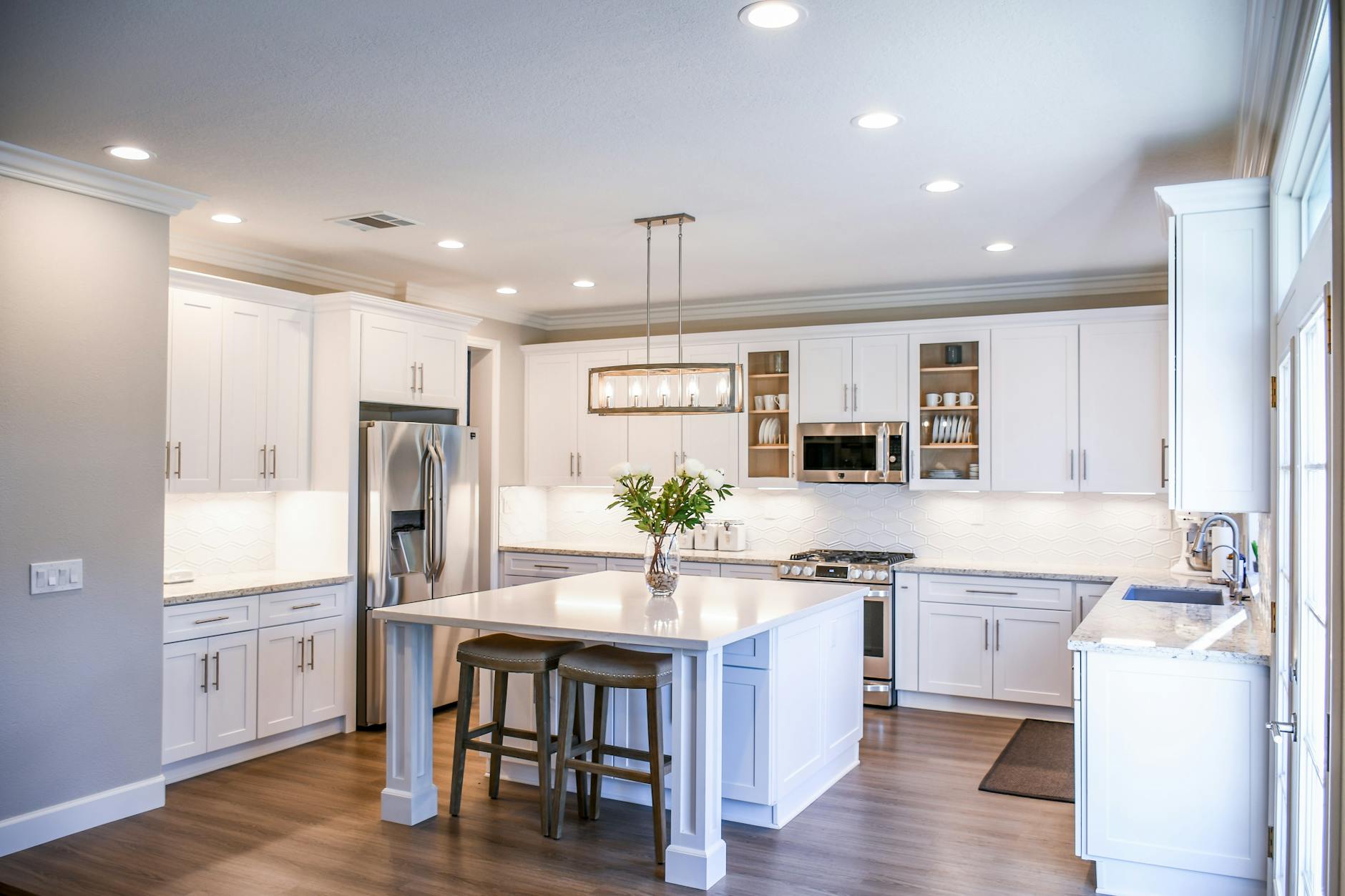
A typical mid-range LA kitchen remodel from the dataset — semi-custom cabinets, quartz counters, stainless appliances. Realistic 2026 budget: $44,200–$94,500.
Finding 6: Composite deck quotes ran 2.4× pressure-treated for the same square footage
On the 9 deck quotes we collected, the material-cost ratio was striking:
- Pressure-treated lumber: median $32/sq ft installed
- Cedar: median $54/sq ft installed
- Composite (Trex, TimberTech): median $77/sq ft installed
- Tropical hardwood (ipe): median $93/sq ft installed
The composite-vs-pressure-treated ratio was 2.4× — meaning a 300 sq ft pressure-treated deck at $9,600 became a $23,100 composite deck. That's the upfront cost of skipping 25 years of staining and board replacement. For homeowners staying 7+ years, the math usually favors composite. For shorter-tenure owners or rentals, pressure-treated wins on ROI almost every time.
Finding 7: Roof quotes converged tightly — except when "secondary water barrier" varied
The 8 roof quotes were the tightest cluster in the entire dataset (18% spread), with one consistent outlier: secondary water barrier inclusion. About a third of the quotes included a self-adhered underlayment and a third didn't, with a third leaving it ambiguous. The water barrier adds $400–$1,200 to the project but is a code requirement in many CA jurisdictions — and homeowners who skipped it on the bid found out at inspection.
What to ask: "Is a self-adhered secondary water barrier included on the full roof deck, or only on the eaves and valleys?" Quote-to-quote consistency on this single line item can change the comparison by $1,000+.
Finding 8: 64% of quotes had at least one math error in the homeowner's favor
This was the most surprising pattern. Across 47 quotes, 30 of them (64%) had at least one small line-item math error. Of those:
- 21 errors favored the homeowner (line items missing or undercounted)
- 9 errors favored the contractor (double-counted line items or inflated unit costs)
Errors weren't fraud — they're the natural result of a one-person estimator manually keying line items into a contractor's estimating software in a hurry. But the asymmetry matters: when a contractor finds a $1,500 mistake in their own bid mid-project, they often bring it up as a change order. So treat the lowest-priced quote with extra scrutiny — the savings might evaporate the first time the contractor "discovers" something missing.
Putting it all together — the 5 questions to ask every LA contractor
Based on the patterns across these 47 quotes, here are the questions that consistently separated tightly-priced bids from loose ones:
- Is your bid scope-locked? Meaning: if you find rotted subfloor, hidden mold, or knob-and-tube wiring, what's the change-order pricing model? Locked bids shouldn't move on unforeseen conditions inside agreed scope.
- What's specifically excluded? Demand a one-paragraph "exclusions" section. The bids in our dataset that didn't have one were the ones that ballooned later.
- Are permits and inspections included? About 30% of quotes excluded permit fees as "owner pays" without flagging it.
- What's your payment schedule, and is it milestone-based? Anything requesting more than 10% upfront in CA violates state law (CSLB B Class limit).
- Will you provide lien waivers at each milestone? Of the 18 LA homeowners in this dataset, only 6 reported being offered lien waivers without asking.
Want to compare your own quote against the dataset?
Use our state-adjusted calculator to see what a project of your size and scope should cost in LA in 2026. Compare your contractor's number — if it's outside the calculator range by more than 20% in either direction, that's your signal to dig into the line items:
- Bathroom remodel cost calculator (CA)
- Kitchen remodel cost calculator (CA)
- Deck construction cost calculator (CA)
- Roof replacement cost calculator (CA)
Or read our deeper city-by-city breakdowns for California bathroom remodels and California kitchen remodels.
More cost guides for California
Planning multiple projects? Every other 2026 California cost guide carries the same state-specific labor and pricing detail.
- Cost GuideBasement Finishing Cost in California 2026
- Cost GuideBathroom Remodel Cost in California 2026
- Cost GuideDeck Construction Cost in California 2026
- Fence InstallationFence Installation Cost in California 2026 — WUI Fire Rules, Labor Premium & HOA Reality
- Cost GuideFlooring Installation Cost in California 2026
- Cost GuideHardscape Installation Cost in California 2026
- HiringHiring a Contractor: A Homeowner's Checklist
- HVACHVAC Cost in California 2026 — Title 24, Heat-Pump Mandate, and the True Cost After TECH Rebates
- Pool InstallationIn-Ground Pool Cost in California 2026 — Why CA Pools Cost 30-45% More
- PaintingInterior & Exterior Painting Cost in California 2026 — Why CA Painting Runs 25-40% More
- Cost GuideKitchen Remodel Cost in California 2026
- Cost GuideLandscaping Cost in California 2026
- Solar Buyer's GuideNEM 3.0 Explained for California Homeowners (2026)
- RoofingRoof Replacement Cost in California 2026 — Title 24, Cool Roofs, and the WUI Zone Surcharge
- Solar PanelsSolar Panel Cost in California 2026 — What 8 kW Systems Actually Run (Post NEM 3.0)
- Window ReplacementWindow Replacement Cost in California 2026
Cost by state for this project
State-adjusted ranges with local labor and material multipliers.