Cost Analysis
The 9 Renovation Costs That Surprise Homeowners Most (2026 Edition)
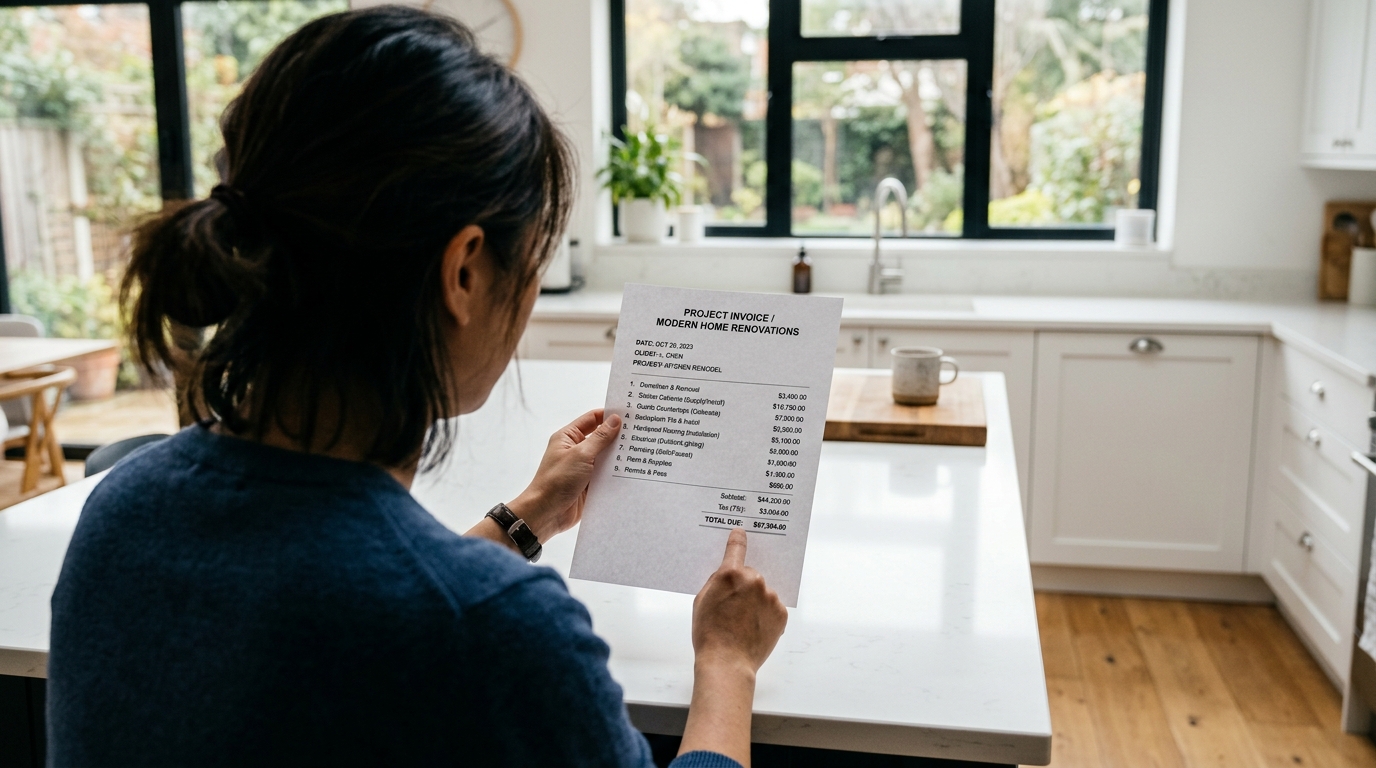
Every renovation has a "wait, that costs HOW much?" moment. We've surveyed homeowners on completed projects across the country and the same 9 cost categories show up over and over — items that weren't in the initial budget conversation, sometimes weren't in the contractor's first bid, and almost always blow past whatever vague mental estimate the homeowner had walked in with. Here's the 2026 breakdown of each, why they're systematically underestimated, and exactly what to do.
1. Permits and inspections — $200 to $4,500
Most homeowners assume permits are a flat $100 fee, when in reality permit cost scales with project size, is charged per-discipline (plumbing, electrical, mechanical, building all separate), and varies wildly by municipality. A San Francisco kitchen remodel can need $3,200 in permits; an unincorporated Tennessee rural county might charge $185 for the same project. Hidden because: bids often say "permits as required" without a dollar figure. What to do: require the contractor to specify permits as a line item with an estimated dollar range, OR mark it "by homeowner" and pull them yourself for cost transparency.
2. Demolition and disposal — $800 to $4,500
Tearing out is harder than it sounds. A bathroom demo for a remodel involves removing tile (often thinset-bonded to concrete board), the tub or shower, vanity, toilet, flooring, sometimes the wall framing — and then a dumpster has to be rented, filled, and hauled. Dump fees alone run $80-$220/ton in most metros. Hidden because: contractors price the new work clearly but lump "demo" into one vague line. What to do: ask for demo + disposal as 2 separate line items, with specific dumpster size + dump fee estimate.
3. Electrical panel upgrades — $1,500 to $4,800
Older homes (pre-1990) often have 100-amp panels with no spare breaker slots. Add a kitchen remodel with a new induction range, dishwasher, microwave, and disposal — and the inspector requires a 200-amp panel upgrade. This is the single most common "unexpected" cost on kitchen remodels. Hidden because: nobody knows the panel is undersized until the electrician opens it. What to do: have an electrician open your panel during the bid phase (typically a free or $100 visit). If it's at capacity, price the upgrade upfront — not as a panicked change order mid-project.
4. HVAC duct relocation — $600 to $3,200
Move a wall in a kitchen, basement, or bathroom and you'll often find a duct running through it. Relocating ductwork requires an HVAC sub (different trade, different schedule), and rerouting a single run typically adds 2-4 days to the project. Hidden because: ducts aren't visible during walkthroughs — they show up during demo. What to do: for any project that involves moving a wall or significant ceiling work, walk the basement/attic with the contractor and physically trace where ducts run. Surface this before bidding.
5. Subfloor repair — $400 to $2,800
Pull up old tile or vinyl flooring in any bathroom or kitchen and there's a meaningful chance the subfloor underneath has water damage, rot, or just isn't level enough for modern tile (which is more brittle than older materials). Hidden because: the subfloor is literally invisible until demo. What to do: add a $1,500 contingency line specifically for subfloor remediation on any bathroom or kitchen project. If it's not needed, it stays in your pocket.
6. Pre-existing code violations brought to current code — $500 to $5,000+
Inspectors don't grandfather everything. If your existing electrical, plumbing, or framing doesn't meet current code AND it's in the area being remodeled, the inspector can require bringing it to code as part of the permit close-out. Knob-and-tube wiring in the walls behind a kitchen remodel? Re-wire it. Galvanized water lines? Replace them. Insufficient header above the new opening? Reframe it. Hidden because: nobody knows what's in the walls until demo. What to do: for any home built before 1985, add a 10% contingency line specifically for code-compliance issues uncovered during construction.
7. Final-finish materials creep — $1,200 to $6,000
"Allowances" in a contractor's bid are placeholder dollar amounts for fixtures, tile, hardware, lighting, etc. ("$2,500 allowance for tile.") Homeowners walk into the showroom, fall in love with something at $14/sqft instead of $7/sqft, and suddenly the tile bill is $4,800 instead of $2,500. Same thing happens with faucets, vanities, light fixtures, and cabinet hardware. Hidden because: allowances feel like real budget when they're really placeholders. What to do: spend 2 hours at the showroom BEFORE signing the contract and pick actual products. Bake the real cost in, not an arbitrary allowance.
8. Project-management and "general conditions" — 5-10% of contract
Some contractors price labor + materials + markup and call it done. Others (usually larger shops) add 5-10% for "general conditions" — site cleanup, temporary protection, port-a-potty, dumpster rotation, project management hours, trash hauling, etc. Hidden because: on a $40K bathroom that's $2,000-$4,000 buried in a line item most homeowners never read. What to do: ask "is there a general conditions or project management line item? How much, and what does it cover?"
9. The contractor's contingency clause — typically 10-15%
Most well-written contracts include a 10-15% contingency line — a pool of money set aside for legitimately unforeseen conditions during construction (the items #4, #5, #6 above). On a $30,000 bathroom that's $3,000-$4,500. If the contingency isn't used, you don't pay it. But many homeowners budget $30,000 because that's the contract price, not realizing the contract assumes contingency will be partially or fully consumed. Hidden because: contingency is a real line but feels optional. What to do: budget at the contract total INCLUDING full contingency; treat the contingency as expected, not bonus. If it comes back to you, great. If you budgeted without it, you're underwater on day one.
How to surface these BEFORE you sign anything
Walk through this checklist with every contractor during the bid phase:
- Are permits a separate line item with a dollar range? (#1)
- Is demo separated from new work, with disposal explicitly priced? (#2)
- Has an electrician opened my panel and confirmed capacity? (#3)
- Have we physically traced ductwork through any walls being moved? (#4)
- Is there a subfloor contingency on bathroom/kitchen projects? (#5)
- For any home over 40 years old, is there a code-compliance contingency? (#6)
- Have I picked actual products instead of accepting allowances? (#7)
- Are general conditions / PM costs a line item I can see? (#8)
- Am I budgeting at contract total INCLUDING contingency? (#9)
For the line-by-line breakdown of what a clean estimate should look like, see our how-to-read-a-contractor's-estimate guide. To understand how change orders compound these issues, our change order markup guide covers what a fair contractor markup actually looks like in 2026. And for the underlying state-by-state cost baseline, run our bathroom, kitchen, or basement calculators with your state selected.
Bottom line
None of these 9 categories are scams or padding. They're real costs that exist on every renovation and quietly compound when nobody asks the right questions early. Walk into your first bid meeting with the checklist above and you'll catch 80% of the surprises before they hit your wallet — turning the typical "we went $12,000 over budget" story into "we came in $1,800 under budget thanks to a contingency line we didn't fully use."