Smart Home
Smart Home Upgrade Cost Guide 2026 — Real Prices for Every Common Device
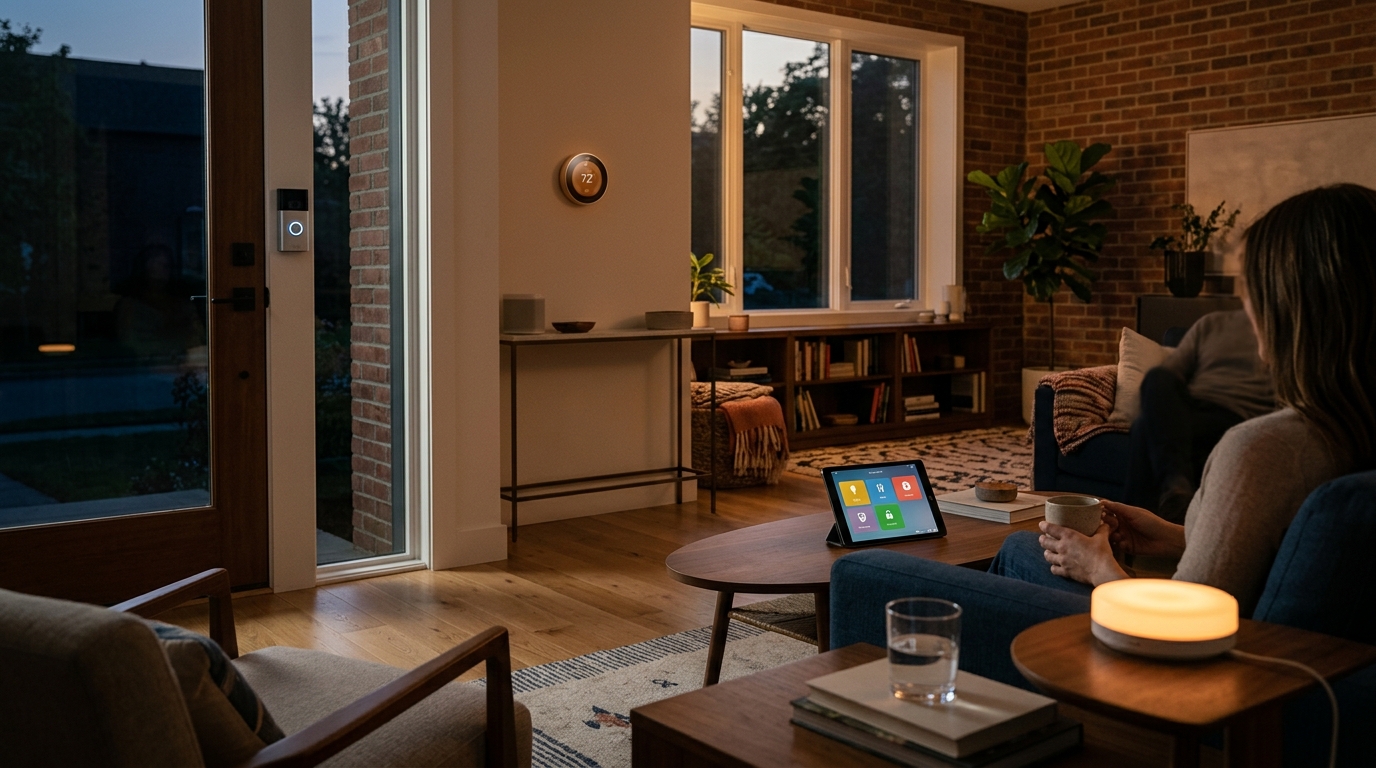
"Smart home" is no longer a single product category — it's two dozen overlapping markets, each with its own ecosystem, install profile, and ongoing-cost surprise. Some pay back fast in convenience and resale; others burn cash on subscription fees and proprietary lock-in. Here's the honest 2026 price guide, organized by category, with installed cost ranges, what's worth it, and the traps to avoid.
Smart video doorbells — $150–$450 installed
The single most popular smart-home category in 2026, and the one with the clearest resale impact (more on that below). Three price tiers:
- Battery-powered ($150–$220 installed): Easiest install — no electrical work. Battery lasts 3–6 months between charges. Best for renters or homes without existing doorbell wiring.
- Hardwired ($180–$320 installed): Replaces an existing doorbell. Pulls power from the doorbell transformer. No battery hassle. The mainstream choice.
- Premium dual-camera ($350–$450 installed): Adds a downward-facing package camera, doorbell chime in-home, and on-device facial recognition. Worth it if you receive deliveries weekly.
Ongoing cost: Most brands now require a $3–$10/month subscription to access cloud recording. Without the subscription, you only see live video — no event playback. Budget the subscription fee into your decision; over 5 years a $5/month plan costs $300 — sometimes more than the camera itself.
Smart locks — $180–$400 installed
Replaces the deadbolt with a Bluetooth/Wi-Fi-enabled lock that opens with a keypad, phone, or biometric. Two important sub-types:
- Deadbolt-only smart locks ($180–$280): Drop-in replacement for a standard deadbolt. 1-hour DIY install for most homeowners. The 80/20 pick.
- Smart-lever locks ($280–$400): Replaces both the deadbolt AND the door handle in one matched set — looks more integrated, costs more, harder retrofit.
Watch for: Battery anxiety (most run on 4 AA cells, 6–10 months) and lockout risk if the battery fully drains. Pick a model with a 9V backup terminal or a physical key override.
Smart thermostats — $240–$520 installed
The smart-home upgrade with the most legitimate energy payback. A $250 Nest or ecobee with proper scheduling cuts heating/cooling bills 8–15% — typically $80–$180/year — and most utilities offer $50–$100 rebates that cut the install cost by a third on day one.
- Self-install ($240–$320): Most homeowners with a 5-wire HVAC setup can DIY in 30 minutes. Watch for C-wire requirements — older systems may need a power-extender kit or a dedicated wire pull.
- Pro install ($380–$520): If your wiring is 2- or 3-wire (common in older homes), an HVAC tech needs to pull a new conductor or install a power-extender. Adds $80–$200 in labor.
Payback: 18–36 months on energy savings alone — easily the best ROI in any smart-home category. Combine with the federal §25C Energy Efficient Home Improvement Credit for a 30% federal tax credit (up to $1,200/yr combined with other §25C upgrades). See our energy-efficient upgrades guide for the full ranked list.
Smart lighting — $30–$100 per fixture
The category with the biggest range. Three approaches at very different price points:
- Smart bulbs ($30–$60 each): Screw into existing fixtures. Best for accent lights and 2–3 key fixtures. Don't budget this for every bulb in the house — math breaks past 8–10 bulbs.
- Smart switches ($45–$100 installed): Replaces the wall switch instead of the bulb. ONE switch controls ALL bulbs on that circuit. The smart-money pick once you go past 5 bulbs in a room. Requires an electrical permit in some jurisdictions and a neutral wire (many pre-1985 homes lack one).
- Whole-home lighting controllers ($1,500–$4,500 installed): Lutron Caséta or RadioRA in a panelized configuration. New-construction and high-end remodel territory. Adds 1–3% to the home's appraised value at sale.
Smart security systems — $400–$2,400 installed
DIY-monitored ($400–$900): Ring Alarm, SimpliSafe, Abode. You install sensors, app-only monitoring, optional $20–$30/month for professional 24/7 monitoring + cellular backup.
Pro-installed and monitored ($1,200–$2,400 setup + $40–$60/month): ADT, Vivint. Higher install cost, lock-in contracts, but insurance discounts of 5–15% on homeowners premium that partially offset the monthly fee.
Honest assessment: The DIY-monitored tier with professional cell-monitoring layered on top delivers 90% of the security value at 40% of the lifetime cost.
Smart hubs and voice assistants — $40–$300
The plumbing layer that makes everything talk to everything else. Three things to know in 2026:
- Matter is the new standard. Most 2024+ smart devices speak Matter natively, which means they work across Amazon, Google, Apple, and SmartThings without needing a separate hub.
- A standalone hub ($60–$120) is still worth it for older devices. A SmartThings or Hubitat hub bridges legacy Z-Wave and Zigbee gear into Matter, future-proofing a $400–$1,200 sunk investment.
- Voice-only speakers ($40–$150) are an upgrade, not a hub. They don't bridge protocols — they just route commands to whatever's already on your network.
Smart appliances — $300–$1,800 PREMIUM over standard
Refrigerators, washers, dryers, dishwashers, ovens with Wi-Fi connectivity. The smart-home category with the worst cost-vs-value ratio:
- The app rarely does anything useful beyond "tell me my cycle is done."
- The smart features fail or become unsupported in 5–7 years — appliances last 12–18.
- Repair costs are 30–50% higher than non-smart equivalents because the control board is one-of-a-kind and proprietary.
Recommendation: Skip the smart-appliance premium. Spend that $400–$1,500 on a Lutron lighting scene, a great thermostat, or a video doorbell — categories that actually deliver daily value.
Whole-home smart packages — $4,500–$22,000 installed
Pulled together by a custom-integration installer (Crestron, Control4, or a serious Lutron dealer). Covers lighting scenes, AV, shades, thermostat zones, security, and access control through a single touchscreen or app interface. Almost never DIY-installable — these are wired, programmed systems requiring a control contractor.
Three tiers in 2026 for a typical 2,500 sqft single-family:
- Entry tier ($4,500–$8,000): Lutron Caséta whole-home lighting + smart thermostat + smart locks + video doorbell, programmed and integrated.
- Mid-tier ($9,000–$14,000): Adds Lutron RadioRA shades, multi-zone audio, and a control panel.
- High-end ($15,000–$22,000+): Adds whole-home AV distribution, professionally-installed security with cellular backup, and a Control4 or Crestron processor with custom UI.
The hidden cost: ongoing subscriptions
A modern smart home isn't a one-time install — it's a SaaS bill stacking up across categories. Typical monthly outflows in 2026:
- Video doorbell cloud storage: $3–$10/month
- Security monitoring (if used): $20–$60/month
- Whole-home automation cloud sync (Control4, Savant): $10–$30/month
- Smart-thermostat data plan (uncommon, but Ecobee Vista is $5/month): $0–$5/month
- Premium smart-lock features (auto-lock geofencing on August/Nuki): $0–$4/month
Over 5 years, $30/month in subscription fees totals $1,800 — sometimes more than the underlying device cost. Audit subscriptions every January and cancel anything you haven't actively used in 90 days.
The 2026 smart-home buying ladder (in priority order)
If you're starting from zero in 2026, install in this order — biggest impact-per-dollar first:
- Smart thermostat ($240–$520) — pays for itself in energy savings in <3 years.
- Smart video doorbell ($180–$320) — daily convenience + measurable resale impact.
- Smart lock ($180–$280) — solves the keys-for-everyone problem permanently.
- Smart switches in 2–3 high-use rooms ($90–$300) — biggest daily-use upgrade.
- Matter hub ($60–$120) — future-proofs everything above.
- Everything else only as you have a specific use case for it.
Total entry-level smart home: $750–$1,540 installed. Skip the appliances and the whole-home AV distribution unless you're doing a gut renovation already.
Sources & methodology
Pricing data sourced from 2026 manufacturer MSRPs, Houzz pro-installer pricing surveys, ConsumerReports smart-home pricing aggregations, IRS §25C credit guidance (Form 5695), and the 2026 Remodeling Magazine Cost vs Value Report regional adjustments.
Bottom line
The 2026 smart-home market is finally mature enough to deliver real value — IF you focus on the four categories that compound daily (thermostat, doorbell, lock, lighting) and skip the categories that don't (smart appliances, voice-only speakers, anything with a monthly subscription you'd cancel within a year). For most homeowners, a $1,000–$1,500 staged install over 6 months delivers the bulk of the benefit; the next $5,000 delivers maybe 20% more.
Curious whether the upgrades you're considering will actually move your resale number? Read the companion guide: Does smart home technology increase home value?