Renovation Strategy
Home Renovation Checklist — Before You Start Any Project (2026)
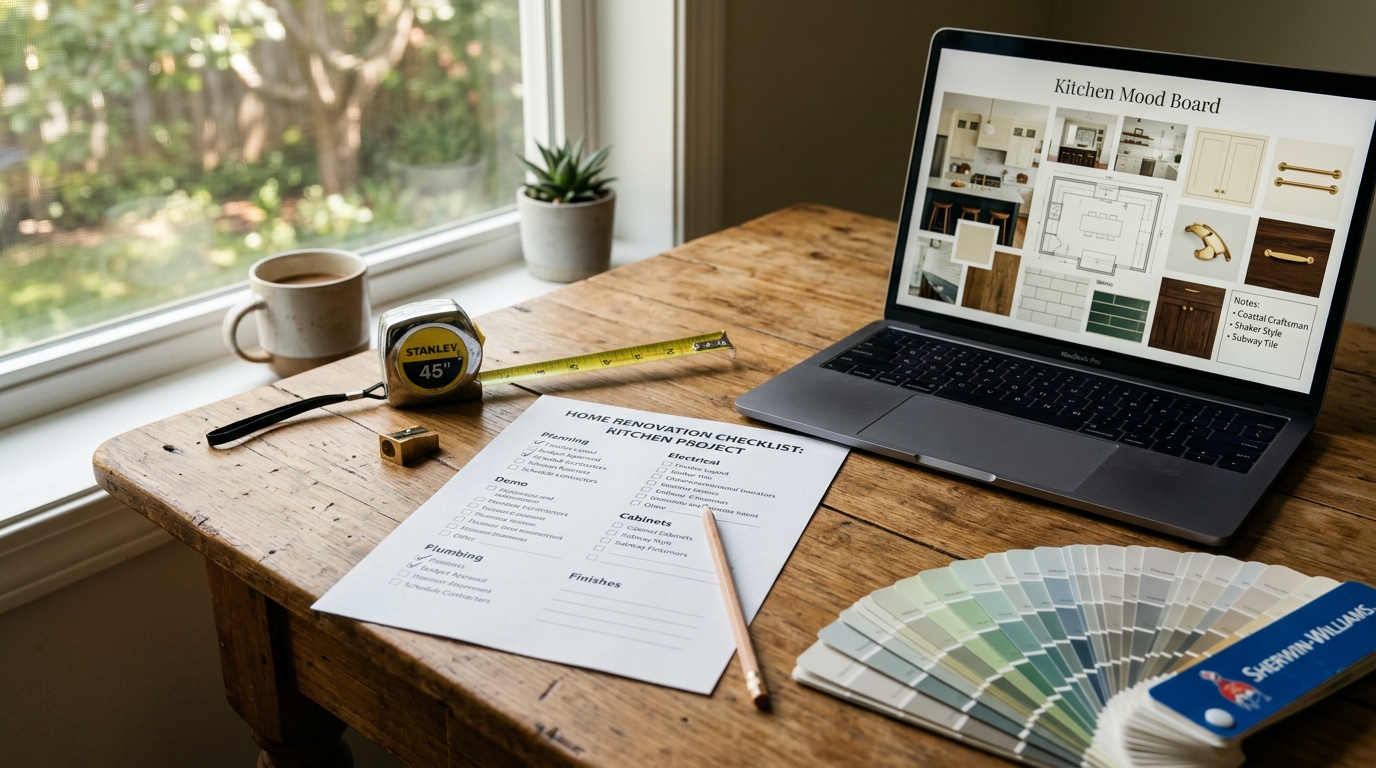
The homeowners who finish renovations on time, on budget, and without litigation have one thing in common: they did the planning work before signing anything. The ones who end up in disputes almost always skipped one of the 40 steps below. This is the complete pre-renovation checklist — scope, budget, financing, contractors, permits, contracts, and timing — organized by the phase you should run through it.
Phase 1 — Scope & vision (2-4 weeks before talking to contractors)
- Write a one-page scope document. Room-by-room: keep / replace / move / new. Include square footage, ceiling height, and any structural changes.
- Decide the "tier" of finish (budget / mid-tier / high-end / luxury). Be honest. This determines your number more than any other single decision.
- Build a Houzz / Pinterest / Instagram inspiration folder. 30-50 saved images. You'll use this with the designer and contractor.
- Identify the 3 must-haves and the 3 nice-to-haves. When budget gets tight, the nice-to-haves are the first to go.
- Confirm structural changes with an architect if you're moving any walls, changing ceiling heights, or modifying load-bearing elements. Architects cost $1,500-$8,000 for typical mid-size renovations and prevent $20K+ mistakes.
Phase 2 — Budget & financing (2-3 weeks)
- Run our cost calculators for every project category you're touching — kitchen, bathroom, basement, roofing, etc. — with your state and quality tier.
- Apply a 15-20% contingency on top of the base budget. For pre-1985 homes, go to 20-25%.
- Identify your financing source: cash, HELOC, home-equity loan, cash-out refi, or renovation loan. See how to finance a home renovation.
- Get pre-approved before bidding. Contractors take serious-buyer signals seriously. Having a pre-approval letter often gets you 5-10% better pricing.
- Budget for living costs. Hotel / rental during the project, restaurant spending during kitchen out-of-service, storage POD if you're moving furniture, etc.
Phase 3 — Design (3-6 weeks)
- Hire a designer or architect if scope is more than $40K or includes structural / layout changes. ROI on the design fee is typically 3-5x on saved scope-creep costs.
- Get to-scale floor plans. 1/4" = 1' is the industry standard. Contractors bid more accurately off real plans than verbal descriptions.
- Select all major finishes BEFORE bidding. Tile, flooring, cabinets, counters, fixtures, lighting. Each undefined finish creates an "allowance" in the contract — which is where budget overruns hide.
- Confirm appliance and fixture lead times. In 2026, custom cabinets run 8-14 weeks, specialty tile 4-8 weeks, designer fixtures 6-12 weeks. Plan around the longest lead.
Phase 4 — Contractor selection (3-5 weeks)
- Get 3 written bids. Not 2. Not 5. Three. Two leaves you without a tie- breaker; five wastes everyone's time. See our hiring-a-contractor checklist.
- Verify each contractor's license + bond + insurance. Call the state licensing board. Verify the bond holder. Get a current certificate of insurance with your name as an additional insured.
- Check 3 references from the last 12 months. Ideally, drive to one of the completed projects.
- Read every Google / Yelp / BBB review from the last 2 years. Pay attention to how complaints are responded to, not just the star rating.
- Confirm the contractor's primary trade. A general contractor who subcontracts everything is fine for big remodels; a hands-on trade contractor is better for single-room jobs.
- Watch out for the lowest bid. If one bid is 25%+ lower than the other two, either they missed scope, they plan to come back with change orders, or they're cutting corners. See our analysis of 47 LA quotes.
Phase 5 — Bid review (1-2 weeks)
- Line-item each bid. Compare across contractors. If contractor A has "flooring: $8,000" and contractor B has "flooring: 1,200 sqft LVP at $7.50/sqft installed incl. underlayment" — B is the one bidding accurately.
- Question every allowance. "Tile allowance: $3,500" is a budget bomb waiting to detonate. Pre-select the tile and have it priced into the contract.
- Confirm the schedule includes weather buffers (for exterior work) and subcontractor lead times.
- Cross-reference against the calculator estimate. If contractor bids are 30%+ higher than our calculator estimate for your state and tier, something's off — push back, ask for line-item justification.
- Decode change-order policy. See our change-order markup guide — this single line item separates the 25% overrun contractors from the 5% overrun ones.
Phase 6 — Contract (1 week)
- Demand a written contract. Verbal agreements are unenforceable in most states for renovation work over $1,000.
- Verify the payment schedule. Industry standard: 10-15% deposit, then milestone payments tied to completed work (NOT to dates). Never pay more than 50% before 50% of the work is done.
- Confirm change-order procedure in writing. Markup percentage, approval process, written sign-off requirement.
- Require lien waivers with every payment to the contractor (and every subcontractor on jobs over $25K).
- Specify warranty terms: labor warranty (typically 1 year), manufacturer warranty pass-through, and call-back procedure for issues.
- Include a clear scope-of-work exhibit — the line-item bid attached as part of the contract. If it's not in the scope exhibit, it's a change order.
- Read every page. If you can't, hire a real estate attorney for 1-2 hours ($300-$600). Cheap insurance on a 5- or 6-figure contract.
Phase 7 — Permits & timing (1-3 weeks)
- Confirm who pulls permits. The contractor should, but verify in the contract. If you pull permits, you become legally responsible for code compliance.
- Check HOA approval requirements. Some HOAs require architectural review for any exterior changes. Approval can take 2-8 weeks.
- Pick the right season. See best time of year to renovate. Late winter / early spring tends to be 5-15% cheaper.
Phase 8 — Logistics (1 week before start)
- Plan for living situations: if it's a kitchen, set up a temporary kitchen in the garage / laundry room. If it's whole-home gut, move out.
- Communicate with neighbors. Especially for exterior or noisy work — a 5-minute conversation prevents 5 weeks of cold-war complaints.
- Set up a project communication system. Weekly 15-minute walk-throughs with the contractor are the single highest-leverage practice in renovation.
Phase 9 — Post-project (1 month)
- Walk the punch list. Don't pay the final 5-10% until every item is complete.
- File all final lien waivers, warranty cards, permits, and as-built drawings. You'll need these when you sell — buyers and appraisers will ask.
The 5 highest-leverage tactics on this list
If you can only do 5 things from this checklist, do these:
- Get 3 written, line-item bids — not lump-sum, not 2 bids, not 5.
- Apply 15-20% contingency to your budget — it will be used.
- Pre-select every major finish before bidding — kill the allowances.
- Tie payments to milestones, not dates.
- Have an attorney review your contract for $300-$600. Single highest- leverage spend in the entire project.
Common mistakes that derail renovations
- Hiring the cheapest bidder without verifying scope match. See our contractor quote analysis.
- Starting without permits. Cost when caught: $5K-$25K + delay + sometimes forced demo.
- Paying too much upfront. Leaves zero leverage when issues arise.
- Skipping the contingency line. 95%+ of renovations have unexpected costs.
- Letting scope expand mid-project without writing it as a formal change order with revised total + new completion date.
Bottom line
The difference between a renovation that finishes on time and budget vs. one that drags 30% long and 30% over isn't luck. It's the 40 items above. The single highest-leverage habit: spend 4-6 weeks planning before you ever sign a contract. Most homeowners spend 2 weeks. The ones who spend 6 weeks save themselves 6 months of pain later. Use our cost calculators with your state to lock in budget numbers, then walk this checklist phase by phase. Print the PDF version (link below) and physically check items off — the act of checking off creates accountability that a digital list rarely does.
Get the printable 40-item checklist (PDF)
Email me the printable 40-item checklist organized by phase — scope, budget, contractors, contracts, timing, and post-project. Take it into every contractor meeting.
Free. One email. Unsubscribe in one click. No spam.